
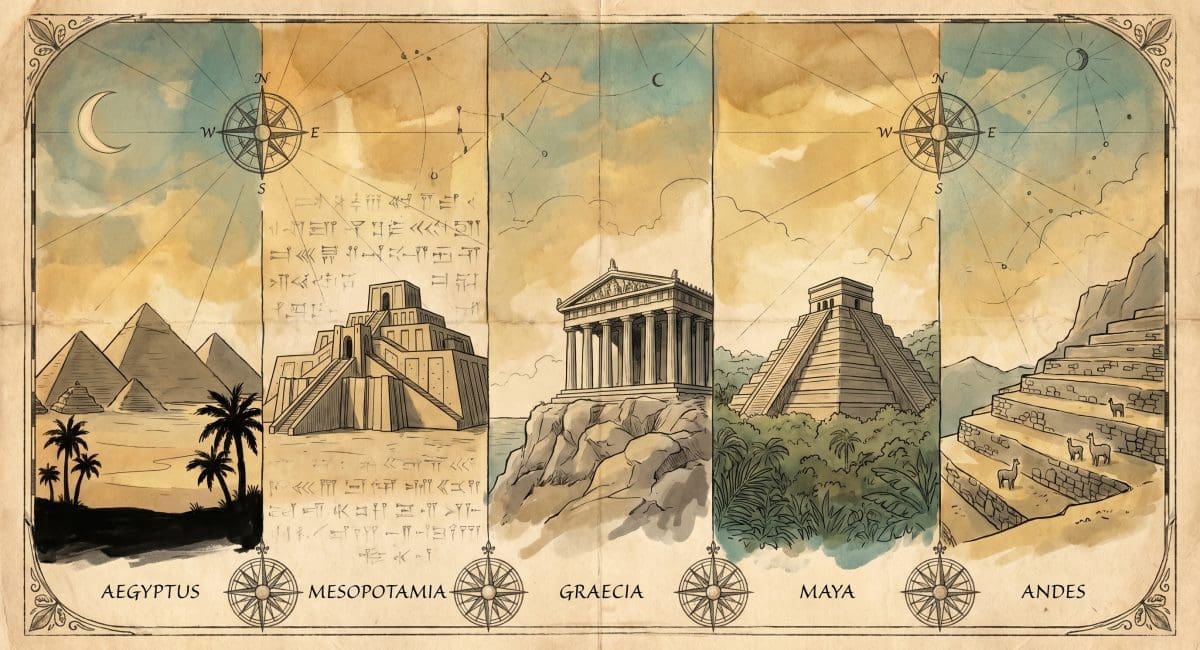
The story of ancient civilizations is really the story of how humans first learn to live together in great numbers. Around the world, a handful of early peoples build cities, invent writing, and create the first governments. This guide walks you through the 13 major ancient civilizations that shape the world we live in today.
Some of these names you know well. Egypt, Greece, and Rome show up in nearly every history class. Others, like Norte Chico in Peru or the Olmec of Mexico, rarely get the spotlight they deserve. Together, these ancient civilizations answer a big question: where does civilization actually come from?
- Civilization
- A complex society with cities, social classes, organized government, and usually a system of writing or record-keeping. A village is not a civilization. A city with rulers, scribes, and laws is.
- Ancient
- In the strict sense, the period from the first cities (around 3500 BCE) to roughly 500 CE. We stretch the word slightly here to include the famous American civilizations, which rise later but fit the same pattern.
- Cradle of civilization
- A place where civilization develops on its own, with no outside teacher. Scholars name six: Mesopotamia, Egypt, the Indus Valley, China, Norte Chico, and the Olmec.
What makes a civilization “ancient”?
A society counts as an ancient civilization when it has cities, a ruling government, distinct social classes, and a way to keep records. Six of these arise completely on their own, with no outside influence. Historians call those six the cradles of civilization.
The word “civilization” trips people up. It does not simply mean “smart” or “advanced.” Plenty of brilliant cultures, like the early San people of southern Africa, live without cities or kings. So they sit outside this particular definition of ancient civilizations, even though their history runs far deeper in time.
The boundary also gets fuzzy at the end. The Aztec and Inca empires rise during Europe’s late medieval period, not the ancient world. Still, most readers expect to find them here, and they match the civilization pattern almost exactly. So I include them, with that timing noted plainly.
The 13 major ancient civilizations at a glance
There is no single official count of ancient civilizations, but historians agree on a core group. This table lists 13 major ancient civilizations with their dates, homelands, writing systems, and signature achievements. Tap any column heading to sort the list.
| Civilization ▴▾ | Flourished ▴▾ | Region (today) ▴▾ | Writing system ▴▾ | Signature achievement ▴▾ | What ends it ▴▾ |
|---|---|---|---|---|---|
| Mesopotamia (Sumer) | c. 4500–1900 BCE | Iraq, Syria | Cuneiform | The first cities and writing | Absorbed by later empires |
| Ancient Egypt | c. 3100–30 BCE | Egypt | Hieroglyphs | Pyramids and a 3,000-year state | Roman conquest, 30 BCE |
| Indus Valley | c. 2600–1900 BCE | Pakistan, NW India | Indus script (undeciphered) | Grid-planned cities | Slow decline, c. 1900 BCE |
| Ancient China | c. 1600–1046 BCE (Shang) | China | Oracle-bone script | Bronze casting, written records | Conquered by the Zhou |
| Norte Chico (Caral) | c. 3500–1800 BCE | Peru | None (quipu cords) | Oldest city in the Americas | Drought, c. 1800 BCE |
| Olmec | c. 1200–400 BCE | Mexico (Gulf Coast) | Early glyphs (limited) | Colossal stone heads | Vanishes, c. 400 BCE |
| Ancient Greece | c. 2000–146 BCE | Greece, Aegean | Greek alphabet | Democracy and philosophy | Roman conquest, 146 BCE |
| Phoenicia | c. 1200–539 BCE | Lebanon, coast | Phoenician alphabet | The alphabet we still use | Persian, then Greek conquest |
| Persia (Achaemenid) | 550–330 BCE | Iran | Old Persian cuneiform | The first world empire | Alexander the Great, 330 BCE |
| Ancient Rome | 753 BCE–476 CE | Italy | Latin alphabet | Law, roads, and concrete | Western empire falls, 476 CE |
| Maya | c. 2000 BCE–1500s CE | Mexico, Guatemala | Maya glyphs | Calendar and the idea of zero | Classic cities collapse, c. 900 CE |
| Aztec (Mexica) | 1325–1521 CE | Mexico | Pictographic (Nahuatl) | The island capital Tenochtitlan | Spanish conquest, 1521 |
| Inca | 1438–1533 CE | Peru, Andes | None (quipu cords) | A road network across the Andes | Spanish conquest, 1533 |
A note on dates: the earliest civilizations leave no calendars of their own, so start and end dates are best estimates that shift as archaeologists dig. Where the record is genuinely unclear, the entries below say so.
The cradles of civilization
A cradle of civilization is a place where civilization begins on its own, with no outside teacher. Scholars recognize six: Mesopotamia, Egypt, the Indus Valley, China, Norte Chico in Peru, and the Olmec in Mexico. Each invents city life independently.
These six ancient civilizations matter most because they prove something remarkable. Civilization is not a one-time accident. Given rivers, farming, and time, humans build cities again and again, on different continents, without ever meeting.
1. Mesopotamia, where cities begin
FactMesopotamia sits between two rivers, the Tigris and the Euphrates. The name itself means “land between the rivers” in Greek. Here the Sumerians build the world’s first true cities around 3500 BCE, including Uruk and Ur.
The Sumerians invent cuneiform, the oldest known writing, by pressing wedge shapes into wet clay. They also give us the wheel, the 60-minute hour, and the first written laws. Nearly every later idea about cities starts here.
Picture flat farmland baked by sun, fed by two unruly rivers that flood without warning. Controlling that water takes teamwork, and teamwork takes leaders. The city is born from a plumbing problem.
2. Ancient Egypt, the gift of the Nile
FactAround 3100 BCE, a ruler unites the lands along the Nile River into a single kingdom. Egypt then lasts, in one form or another, for nearly 3,000 years. Few states in history come close to that run.
Egypt gives us hieroglyphs, vast stone pyramids, and a deep belief in the afterlife. Its independence ends in 30 BCE, when Rome takes over after the death of Cleopatra. You can meet its rulers in our guide to the Egyptian pharaohs.
The Nile floods on a calendar you can almost set a watch to. That yearly gift of rich soil makes Egypt reliable, wealthy, and stable in a way its neighbors envy for centuries.
3. The Indus Valley, history’s quiet giant
Record unclearThe Indus Valley civilization spreads across a huge area of what is now Pakistan and northwest India. Its great cities, Harappa and Mohenjo-daro, follow neat street grids with drains and public baths. That kind of planning is rare anywhere this early.
Here is the catch. Their writing, the Indus script, has never been read. No one has cracked it. So we know how these people live but not what they think, who they pray to, or what they call themselves. We update this entry as scholars learn more.
No grand palaces, no royal tombs, no clear signs of war. The Indus cities look oddly equal and oddly peaceful, which keeps archaeologists guessing about who, exactly, is in charge.
4. Ancient China, the unbroken thread
Part legendChinese tradition names the Xia as the first dynasty, but no solid written proof of it survives. The first dynasty we can confirm with evidence is the Shang, from about 1600 BCE. Its kings cast stunning bronze vessels and write on “oracle bones.”
Those oracle bones carry the ancestor of modern Chinese characters, which makes Chinese writing one of the longest-running systems on Earth. The story continues in our list of Chinese dynasties.
Along the Yellow River, kings ask their ancestors for advice by heating bones until they crack, then reading the cracks. The questions, scratched into the bone, become China’s first written records.
5. Norte Chico, the surprise in the desert
FactOn the dry coast of Peru, the Norte Chico people build the oldest known city in the Americas, Caral, starting around 3500 BCE. That makes it roughly as old as the pyramids of Egypt. For a long time, almost no one knew it was there.
They raise great stone pyramids and sunken plazas, yet leave behind no writing and, strikingly, no signs of war. Instead of letters, they keep records with knotted cords called quipu. UNESCO lists the Sacred City of Caral-Supe as a World Heritage Site.
A bone-dry valley meets a rich Pacific coast. Inland farmers grow cotton for fishing nets; coastal fishers trade back their catch. That simple swap quietly funds a civilization.
6. The Olmec, parent of Mesoamerica
Mother culture debatedThe Olmec flourish on Mexico’s Gulf Coast from about 1200 to 400 BCE. They carve colossal stone heads, some taller than a person and weighing many tons, from single basalt boulders hauled across miles of swamp.
Many scholars call the Olmec the “mother culture” of Mesoamerica, since later peoples share their gods, art, and ball game. Others push back, arguing that influence flows both ways. The honest answer is that the debate is not settled. Then, around 400 BCE, the Olmec simply fade out.
Hot, green, and laced with rivers, the Gulf lowlands give the Olmec rubber trees and rich soil. Those rivers double as highways for moving giant stone heads toward their cities.
The classical Old World
After the cradles come the great classical civilizations of the Mediterranean and Near East. Greece, Phoenicia, Persia, and Rome build on older ideas and spread them far. Their alphabets, laws, and politics still shape daily life in the West.
These four are deeply connected. They trade with one another, borrow from one another, and conquer one another. Greek thinkers read Egyptian math. Romans copy Greek gods. The alphabet on this page traces straight back to Phoenician traders.
7. Ancient Greece, the idea factory
Part legendGreek civilization grows over many centuries, from the Bronze Age Minoans and Mycenaeans to the famous city-states of Athens and Sparta. Its early history mixes real events with myth, so the line between the two stays blurry.
Greece gives the world democracy, philosophy, theater, and the Olympic Games. Rome later conquers it in 146 BCE, then spends centuries copying Greek culture. Explore the rival cities in our guide to the Greek city-states.
A landscape of mountains and islands splits Greece into hundreds of small, fierce, independent cities. They argue, compete, and innovate, because no single king ever pins them all down.
8. Phoenicia, the world’s first traders
FactThe Phoenicians live along the coast of modern Lebanon and rule the Mediterranean by sea. From cities like Tyre and Sidon, they sail everywhere, selling timber, glass, and a rare purple dye prized by kings.
Their greatest export is invisible. To track all that trade, they spread a simple alphabet that becomes the parent of Greek, Latin, and the letters you are reading right now. You meet their world in our overview of Iron Age cultures.
Hemmed in by mountains, the Phoenicians turn to the open sea. Their ships push past every known horizon, planting trading posts as far away as Spain and North Africa.
9. Persia, the first true superpower
FactThe Persian Empire, founded by Cyrus the Great in 550 BCE, becomes the largest the world has ever seen up to that point. It stretches from Egypt to India and rules dozens of different peoples at once.
Persia governs with roads, mail riders, and a light touch that lets conquered peoples keep their gods and customs. That model holds until Alexander the Great topples it in 330 BCE. Its armies clash with Greece in some of the major battles of the ancient world.
To rule lands too vast to cross quickly, Persia builds the Royal Road and a relay of fresh horses. A message can race 1,600 miles in a week, holding the giant empire together.
10. Ancient Rome, the empire that won’t quit
Founding mythLegend says twin brothers, Romulus and Remus, found Rome in 753 BCE. The truth is messier, but the city is real, and it grows from a small town into a republic and then a sprawling empire ringing the Mediterranean.
Rome gives us lasting roads, durable concrete, and legal ideas still used in courts today. The western empire finally falls in 476 CE. Trace its rulers in our lists of Roman emperors and Roman consuls.
Rome sits on the Tiber River, at a crossing point between north and south Italy. That location turns a muddy village into a hub for trade, armies, and ambition.
The great civilizations of the Americas
Three later American civilizations rank among history’s greatest: the Maya, the Aztec, and the Inca. The Maya peak long before European contact, while the Aztec and Inca rise during Europe’s late medieval era and fall fast to Spanish conquest.
These three ancient civilizations build cities, pyramids, and empires fully cut off from the Old World. They invent their own writing, math, and calendars from scratch. That makes them powerful proof of how human societies grow along similar paths.
11. The Maya, masters of time
FactThe Maya build dozens of city-states across what is now Mexico and Central America. Their golden age, the Classic period, runs from about 250 to 900 CE. Then, over a century or so, the great southern cities empty out.
The Maya invent a full writing system, a famous calendar, and the mathematical idea of zero, all on their own. One key fact often gets lost: the Maya never vanish. Millions of Maya people still live in the region today.
Deep rainforest hides stone pyramids that poke above the trees. With no big rivers, the Maya store rainwater in vast tanks, an ever-present worry that may help explain the Classic collapse.
12. The Aztec, lords of the lake
Late “ancient”The Aztec, or Mexica, found their capital Tenochtitlan in 1325 CE on an island in a lake. They build floating gardens, grand temples, and a tribute empire that rules much of central Mexico from one of the largest cities on Earth.
This empire is young, not truly “ancient.” It rises only about 200 years before the Spanish arrive. In 1521, conquistadors and the diseases they carry bring Tenochtitlan down in a single brutal campaign.
Tenochtitlan rises from a lake, linked to shore by long causeways. Canals serve as streets, and floating garden plots feed a city that may hold 200,000 people at its height.
13. The Inca, builders of the Andes
Late “ancient”The Inca forge the largest empire in the ancient Americas, running down the spine of the Andes Mountains from about 1438 CE. They tie it together with thousands of miles of stone roads, rope bridges, and runners carrying knotted-cord messages.
Their mountain estate, Machu Picchu, still stuns visitors today. Like the Aztec, the Inca fall fast. Spanish forces under Francisco Pizarro capture their emperor and break the empire by 1533.
The Andes are brutal terrain, all thin air and sheer drops. The Inca answer with terraced farms cut into mountainsides and roads that climb passes higher than many European peaks.
What happens to the ancient civilizations?
Ancient civilizations end in three main ways: conquest by a stronger power, slow collapse from drought or strain, and quiet change into something new. Very few simply disappear. Most leave behind ideas, languages, and people who carry on.
Look back over the list and a pattern jumps out. Rome conquers Greece and Egypt. Drought drains Norte Chico and likely the Maya cities. Spain topples the Aztec and Inca within a single lifetime.
Yet “the end” is rarely a clean stop. Egyptians still farm the Nile. Millions speak languages descended from these cultures. In my research for this guide, the lesson that stuck with me is simple: these ancient civilizations never fully leave. We live inside what they build. Which of the 13 surprises you most?
Books to take you deeper
Want to go further than this guide? These histories are reader-friendly starting points for the civilizations above, written for curious adults and strong younger readers alike.
- The History of the Ancient World by Susan Wise Bauer — one fast-moving narrative that runs from the first cities of Sumer to the fall of Rome. The best single read for the Old World cradles and classical empires on this page.
- DK Eyewitness: Ancient Civilizations by Joseph Fullman — a photo-packed visual guide built for students and curious browsers, spanning Egypt, Greece, Rome, and the Maya. The pick for younger readers in the family.
- 1491 by Charles C. Mann — an award-winning, eye-opening look at the Americas before Columbus, reaching from the Maya, Aztec, and Inca all the way back to Norte Chico. The deep dive for the American civilizations above.
As an Amazon Associate, Histicle earns from qualifying purchases.
Frequently asked questions about ancient civilizations
What is the oldest ancient civilization?
Mesopotamia is usually named the oldest, with the Sumerians building cities around 3500 BCE. In the Americas, Norte Chico in Peru is the oldest, rising at nearly the same time, around 3500 BCE.
How many ancient civilizations were there?
There is no fixed number, since “civilization” is defined by historians, not by a rulebook. Most lists focus on a core group of 10 to 15. This guide covers 13 of the most important and best documented.
What are the six cradles of civilization?
The six cradles, where civilization arises on its own, are Mesopotamia, Egypt, the Indus Valley, China, Norte Chico in Peru, and the Olmec in Mexico. Each one invents city life with no outside help.
Are the Aztec and Inca really ancient civilizations?
Not in the strict sense. Both rise during Europe’s late medieval period, not the ancient world. Still, they match the civilization pattern so closely that most readers and many lists group them with ancient cultures.
Why do ancient civilizations collapse?
The common causes are conquest, climate trouble like long droughts, and internal strain such as overuse of land or political breakdown. Often several causes pile up at once, rather than a single dramatic event.