
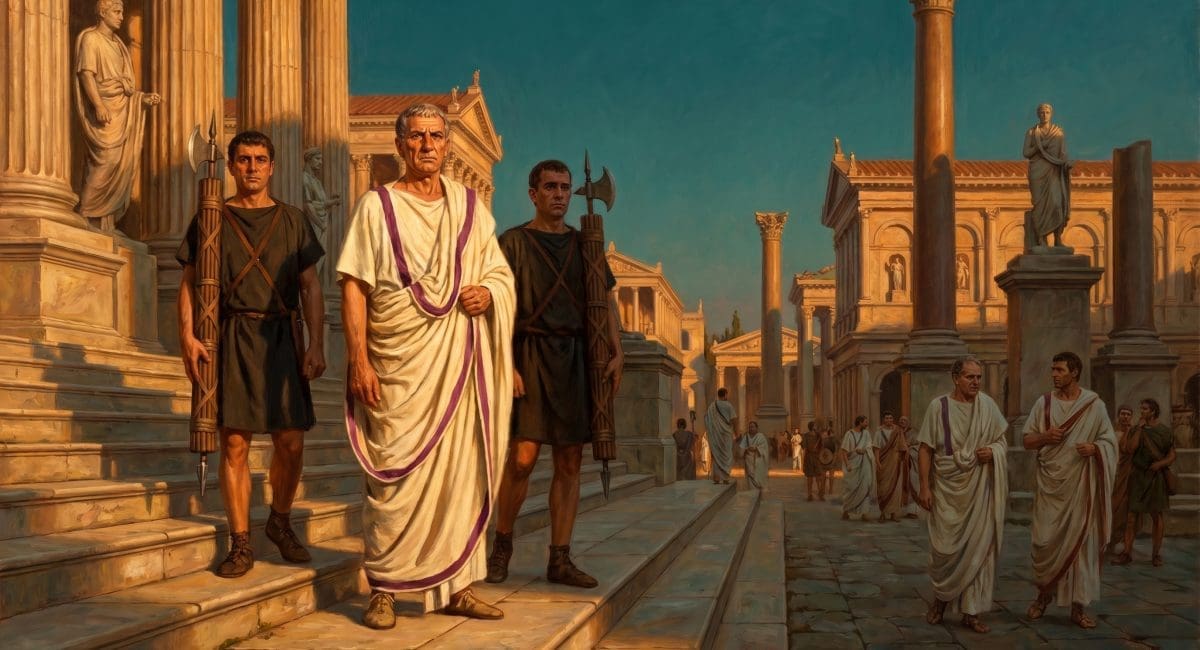
For nearly 500 years, two Roman consuls run the most powerful state in the ancient world — and then they hand it back. The consulship is the top job of the Roman Republic, yet no consul keeps it for long. Two men share it. They serve one year. Then they step aside for the next pair.
That single rule shapes Roman history. It keeps any one person from becoming a king, which is exactly what Rome fears most. This guide explains what Roman consuls really do, how a Roman climbs the ladder to reach the office, and the 15 consuls whose names you still need to know.
Roman consul: the highest elected official of the Roman Republic. Two consuls hold office together each year. They lead the army, run the Senate, and enforce the law. Years are even named after them.
Cursus honorum: Latin for “course of honors.” It’s the fixed ladder of public offices a Roman climbs to reach the consulship. You start low and work up, one rung at a time.
What Roman consuls actually do
Roman consuls are the two chief leaders of the Republic, elected for a single year. They command the army, lead the Senate, propose laws, and act as Rome’s top judges. Each consul can also block the other, so power is always shared.
Rome elects two consuls every year, never one. The Romans build the office this way on purpose. After they throw out their last king around 509 BC, they fear one-man rule above all else.
Each consul holds imperium, the legal power to command soldiers and enforce orders. A consul leads Rome’s legions in war and runs the government in peace. According to the ancient-history site Livius, the consuls and praetors are the most important magistrates of the early Republic.
The two consuls keep each other in check. Either one can veto the other’s decision, so neither can act alone for long. This shared power is the heart of the Roman system. It spreads authority instead of stacking it on one person.
Consuls also give the year its name. Romans don’t count years with numbers the way we do. Instead, they say a thing happens “in the consulship of” two named men. The year 63 BC, for example, is known as the year of Cicero and Hybrida.
The job comes with serious pomp. Twelve attendants called lictors walk ahead of each consul, carrying bundles of rods known as fasces. These bundles signal the consul’s power to punish and command. People step aside when they pass.
The cursus honorum: Rome’s political ladder
The cursus honorum is the set order of offices a Roman holds on the way to consul. The path runs from quaestor to aedile to praetor and finally to consul, with the censorship saved for former consuls. Each step demands more age and more experience.
No Roman jumps straight to the top. The cursus honorum, or “course of honors,” forces every candidate to earn the consulship one office at a time. Each rung teaches a different skill, from money to law to war.
A young man first serves several years in the army. Then he runs for quaestor, the entry-level money office. Next he may seek the aedile post, which runs the city and stages public games. After that comes praetor, a senior judge who also holds imperium.
Only then can a Roman run for consul, the summit of the ladder. A research overview from EBSCO notes that a law passed in 180 BC, the Lex Villia Annalis, sets minimum ages for each office to keep ambitious young men in line.
One office sits outside the normal climb. The censorship is reserved for men who have already served as consul. Two censors are elected every five years, and they run the census and decide who sits in the Senate. The job carries no army command, yet Romans fear it because a censor can remove a senator.
| Office | Min. age | Held by | Main job |
|---|---|---|---|
| Quaestor | ~30 | Many each year | Manage public money and treasury records. The first rung. |
| Aedile | ~36 | Four each year | Run city streets, markets, and the public games. Optional but popular. |
| Praetor | ~39 | Up to eight | Act as senior judge. Holds imperium and can command an army. |
| Consul | ~42 | Two each year | Lead the state and the legions. The top elected office. |
| Censor | Ex-consuls | Two every 5 years | Run the census and revise the Senate roll. Most respected office. |
| Tribune of the plebs | Plebeians only | Ten each year | Protect common citizens. Can veto almost any act. A separate track. |
The confusing parts of the consul lists, explained
Old lists of Roman consuls include some puzzling entries. Suffect consuls are mid-year replacements, consular tribunes stand in for consuls in some early years, and a few years record dictators or no leaders at all. Knowing these terms makes any consul list easy to read.
The full list of Roman consuls can look strange at first. It holds names and labels that don’t appear in modern government. A few simple terms clear up most of the confusion.
A suffect consul is a replacement. When a consul dies or resigns during his year, Rome elects a “suffectus” to finish the term. Under the emperors, this becomes common, and several men hold the office in a single year.
Early lists also show consular tribunes. For parts of the period from 444 to 367 BC, Rome elects a board of three to six “military tribunes with consular power” instead of two consuls. This lets more men, including some plebeians, share the top command.
A few years list a dictator instead of consuls. Rome appoints a dictator only in a crisis, and only for six months. You will also see the decemviri, a board of ten men who write Rome’s first law code, the Twelve Tables, around 451 BC. A handful of years record no magistrates at all, which scholars call the “years of anarchy.”
Most consul lists follow a dating system tied to the scholar Varro, who works in the 1st century BC. As the Roman history site UNRV explains, the dates before 300 BC carry known errors, because Rome’s early records are thin and later writers fill the gaps. From 300 BC onward, the lists are widely trusted. We flag the shakiest early names below so you know where the record gets firm.
15 Roman consuls who changed Rome
These 15 Roman consuls shape the Republic across its whole life, from its first year to its last. They include legendary founders, war heroes against Hannibal, and the strongmen whose rivalries end the Republic itself. Each name below marks a turning point in Roman history.
Rome elects more than a thousand consuls over the centuries. Listing every one would fill a phone book. Instead, here are 15 who truly change the course of Roman history, in order from first to last.
| # | Consul | Consul year(s) | Why he matters |
|---|---|---|---|
| 1 | Lucius Junius Brutus | 509 BC | Traditional first consul; helps overthrow the kings. |
| 2 | Publius Valerius Publicola | 509, 508, 507, 504 BC | Co-founder of the Republic; passes early citizen-rights laws. |
| 3 | Lucius Quinctius Cincinnatus | 460 BC | Model of duty; gives up total power to return to his farm. |
| 4 | Appius Claudius Caecus | 307, 296 BC | Builds the Appian Way; first Roman known in real detail. |
| 5 | Quintus Fabius Maximus | 233, 228, 215, 214, 209 BC | “The Delayer” who wears Hannibal down by avoiding battle. |
| 6 | Scipio Africanus | 205, 194 BC | Beats Hannibal at Zama and wins the Second Punic War. |
| 7 | Cato the Elder | 195 BC | Famous censor; demands the destruction of Carthage. |
| 8 | Scipio Aemilianus | 147, 134 BC | Destroys Carthage in 146 BC, ending the Punic Wars. |
| 9 | Gaius Marius | 107, 104–100, 86 BC | Consul seven times; reshapes the army and breaks the rules. |
| 10 | Lucius Cornelius Sulla | 88, 80 BC | Marches on Rome and rules as dictator, then steps down. |
| 11 | Pompey the Great | 70, 55, 52 BC | Star general; joins the First Triumvirate, then fights Caesar. |
| 12 | Marcus Licinius Crassus | 70, 55 BC | Rome’s richest man; crushes the Spartacus revolt. |
| 13 | Cicero | 63 BC | Great orator; stops the Catiline plot during his term. |
| 14 | Julius Caesar | 59, 48, 46, 45, 44 BC | Wins Gaul and civil war; his rule ends the Republic. |
| 15 | Augustus (Octavian) | 43 BC, and many later | First emperor; turns the consulship into a token honor. |
Rome is a small city fighting its neighbors in central Italy. The Republic is brand new, and its records are thin. The men in this era live partly in legend, yet Romans hold them up for centuries as models of duty and courage.
1. Lucius Junius Brutus
Brutus is the man Rome credits with ending the monarchy. The story says he leads the revolt that drives out the last king, Tarquin the Proud, then becomes one of the first two consuls.
His tale is dramatic and partly legendary, since Rome writes it down centuries later. Still, his name carries huge weight. Many years on, his descendant joins the plot to kill Julius Caesar, hoping to save the Republic the first Brutus helped create.
2. Publius Valerius Publicola
Publicola stands beside Brutus as a founder of the Republic. He serves as consul four times in its first years, a sign of how fragile and dangerous those early days are.
His nickname means “friend of the people.” Roman writers say he passes laws that protect citizens from harsh treatment by their leaders. Like Brutus, he lives in a misty period where fact and legend blur together.
3. Lucius Quinctius Cincinnatus
Cincinnatus becomes Rome’s favorite hero of self-control. The famous story finds him plowing his field when messengers beg him to take total power as dictator and save a trapped army.
He accepts, wins the war in days, then gives up his power and goes back to farming. Whether every detail is true or not, Romans tell this story for centuries. Centuries later, it even inspires the name of Cincinnati, Ohio.
Rome grows from a regional power into the master of the Mediterranean. It fights brutal wars against Carthage, led by the brilliant general Hannibal. By the end of this age, Carthage is ash and Rome stands unmatched.
4. Appius Claudius Caecus
With Appius Claudius Caecus, the record gets solid. Britannica notes he is essentially the first Roman whose life historians can trace with real detail.
His biggest mark comes as censor, not consul. He launches the Appian Way, Rome’s first great road, and the Aqua Appia, its first aqueduct. Both still carry his name today. He also opens the Senate and the vote to a wider group of citizens.
5. Quintus Fabius Maximus
Fabius earns the nickname “Cunctator,” meaning “the Delayer.” When Hannibal smashes Roman armies in open battle, Fabius refuses to fight him head-on.
Instead, he shadows Hannibal, cuts his supplies, and wins small fights on his own terms. Romans mock the slow plan at first. After the disaster at Cannae, they admit Fabius is right. His patient style is still called “Fabian strategy” today.
6. Scipio Africanus
Scipio is the general who finally beats Hannibal. He learns from Rome’s defeats, then carries the war to Africa instead of waiting at home.
In 202 BC, he crushes Hannibal at the Battle of Zama and ends the Second Punic War. The win earns him the name “Africanus.” You can read more about that clash in our list of the major battles of the ancient world.
7. Cato the Elder
Cato is famous for being strict, blunt, and deeply old-fashioned. As censor he attacks luxury and waste, and he becomes a symbol of stern Roman values.
He is best known for one demand. Cato ends nearly every Senate speech with the line that Carthage must be destroyed. He does not live to see it, but Rome follows his advice within a few years.
8. Scipio Aemilianus
Scipio Aemilianus finishes the job Cato calls for. In 146 BC, his army takes Carthage after a long siege and burns it to the ground.
The fall of Carthage ends the Punic Wars for good and leaves Rome as the unchallenged power of the western Mediterranean. He later wins another hard war in Spain, sealing his fame as a soldier.
With its enemies beaten, Rome turns on itself. Generals grow more powerful than the Senate, armies become loyal to their leaders, and civil wars erupt. The consulship becomes a prize that strongmen fight over, and the Republic slowly dies.
9. Gaius Marius
Marius breaks the rules in a big way. Britannica records that he holds the consulship seven times, far past the usual limit of one or two.
He saves Italy by defeating two invading tribes, the Teutones and the Cimbri. He is also credited with reforms that open the army to poor citizens, though modern scholars now question how much of that change is truly his. His repeated terms show how one popular general can bend the system.
10. Lucius Cornelius Sulla
Sulla does the unthinkable: he marches his own army on the city of Rome. No Roman general has ever turned the legions against the capital before.
He seizes power and rules as dictator, punishing his enemies harshly. Then he shocks everyone by giving up power and retiring. His career proves a general with a loyal army can simply take the Republic by force.
11. Pompey the Great
Pompey is the superstar general of his day. He clears the seas of pirates and wins wars across the east, earning the title “the Great.”
He joins Caesar and Crassus in a secret deal called the First Triumvirate to control Roman politics. The partnership later breaks, and Pompey ends up fighting Caesar in a civil war that he loses.
12. Marcus Licinius Crassus
Crassus is the richest man in Rome, and he uses that wealth to buy political power. He is the third member of the First Triumvirate with Caesar and Pompey.
He defeats the famous slave revolt led by Spartacus. Hungry for military glory of his own, he later invades the east and dies in a crushing defeat at Carrhae in 53 BC.
13. Cicero
Cicero rises to consul without a famous family behind him, which is rare. He wins on the strength of his skill as the greatest speaker in Rome.
During his year as consul, he uncovers and stops the Catiline conspiracy, a plot to seize the government by force. His speeches and letters survive today and tell us more about Roman life than almost any other source.
14. Julius Caesar
Caesar is the most famous Roman of all, and his first consulship in 59 BC launches his rise. He conquers Gaul, builds a fiercely loyal army, and crosses the Rubicon to start a civil war.
After winning, he gathers more and more power until senators fear he wants to be king. They kill him on the Ides of March, 44 BC. His death does not save the Republic; it speeds its end.
15. Augustus (Octavian)
Caesar’s heir, Octavian, wins the final round of civil wars. He takes the name Augustus and becomes Rome’s first emperor in 27 BC.
Augustus keeps the consulship alive but drains it of real power. From now on, emperors decide who holds the office. To trace what comes next, see our list of the Roman emperors from Augustus to the end.
How the consulship changes under the emperors
Under the emperors, the consulship survives but loses its power. Emperors hand the office to friends and family, often for only a couple of months, so many men can claim the honor. The last consuls serve in the 6th century AD before the office finally disappears.
The fall of the Republic does not end the consulship. The office lasts for centuries more, but it changes completely. The emperor now holds the real power, and the consul becomes a figure of honor rather than command.
Emperors hand out the office like a reward. They often serve only a couple of months, then step down so another man can hold it. As the history site Livius notes, this lets a dozen senators hold the empire’s highest office in a single year.
The office slowly fades. The last consul in the west serves in 534 AD, and the last in the east serves in 541 AD. After that, the emperors absorb the title entirely, and the 1,000-year story of the Roman consuls comes to a quiet close.
Where to find the complete list of every Roman consul
This page spotlights the most important Roman consuls, not every single one. To find a full year-by-year list of all consuls, the best sources are the academic reference works and detailed databases listed below.
We focus on the 15 consuls who change history, because a list of every name would run past a thousand entries. If you need the complete record, a few trusted sources have it.
- The standard scholarly work is T. R. S. Broughton’s The Magistrates of the Roman Republic, found in most university libraries.
- UNRV’s consul list offers a long year-by-year table from 509 BC onward, drawn from ancient sources.
- World History Encyclopedia gives clear, well-sourced background on the Republic and its offices.
Further reading on the Roman Republic
Want to go deeper into the rise and fall of the Republic? These well-regarded books bring the era to life, from its proud beginnings to its violent collapse.
- SPQR: A History of Ancient Rome by Mary Beard — a sharp, readable history of Rome from a leading classicist.
- The Storm Before the Storm by Mike Duncan — covers the chaos that sets up the Republic’s fall, including Marius and Sulla.
- Rubicon: The Last Years of the Roman Republic by Tom Holland — a gripping account of the era of Pompey, Cicero, and Caesar.
Frequently asked questions about Roman consuls
How many Roman consuls were there each year?
Rome elects two consuls each year. They share power equally and can veto each other. In rare years, a replacement “suffect” consul finishes the term of one who dies or resigns.
How long did a Roman consul serve?
A Roman consul serves for one year. The short term is on purpose, since Rome wants to stop any leader from gaining lasting power. A consul usually had to wait ten years before running again.
Who was the first Roman consul?
Tradition names Lucius Junius Brutus as one of the first two consuls in 509 BC, after Rome throws out its kings. His story mixes fact and legend, since Romans wrote it down centuries later.
What is the difference between a consul and an emperor?
A consul is an elected leader of the Roman Republic who serves one year and shares power with a partner. An emperor rules for life with near-total power. Emperors keep the consul title alive, but only as an honor.
What does cursus honorum mean?
Cursus honorum is Latin for “course of honors.” It is the fixed order of public offices a Roman holds on the way to consul, running from quaestor up through praetor. Each step requires more age and experience.
Curious who comes after the Republic? Explore our complete list of the Roman emperors, or compare Rome’s system with the city-states of Greece in our guide to the Greek city-states and poleis.