
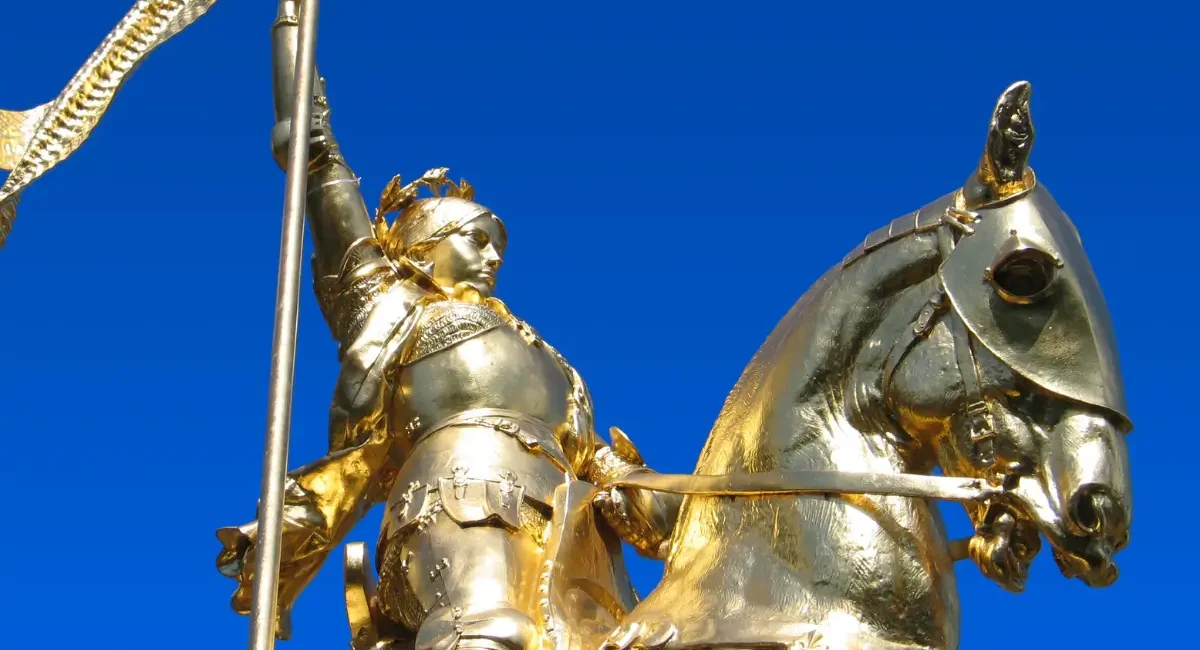
History is full of soldiers who picked up a sword and never looked back. But a few remarkable people picked up the sword, put it down, and found a higher calling — one that eventually led them to sainthood. These are the warrior saints.
They come from different centuries, different countries, and different corners of the Christian world. What they share is a story that starts on the battlefield and ends in the history books of faith. Some died for their beliefs. Some walked away from military glory to live simply. A few did both.
This list covers twelve of the most compelling figures in that tradition. Along the way, we’ll separate documented history from legend — because with warrior saints, the two often get tangled together — and we’ll explain what made each figure significant to believers then and now.
What is a warrior saint? A warrior saint is a person canonized by a Christian church who had a military background, died defending the faith, or became a symbol of spiritual courage through legendary combat imagery. Most early warrior saints were Roman soldiers martyred during the Empire’s persecution of Christians. The term is used across Catholic, Orthodox, and some Anglican traditions.
A Quick Look: 12 Warrior Saints at a Glance
| # | Saint | Period | Origin | Key Role |
|---|---|---|---|---|
| 1 | Saint Longinus | 1st century AD | Roman Empire | Soldier at the Crucifixion |
| 2 | Saint Cornelius the Centurion | 1st century AD | Roman Empire | First Gentile Christian convert |
| 3 | Saint Martin of Tours | 4th century AD | Roman Empire (Hungary) | Soldier turned monk and bishop |
| 4 | Saint George | 3rd–4th century AD | Roman Empire (Turkey) | Martyr, patron saint of England |
| 5 | Saint Demetrius of Thessaloniki | 3rd century AD | Greece | Roman officer, martyr |
| 6 | Saint Maurice | 3rd century AD | Egypt | Commander of the Theban Legion |
| 7 | Saint Sebastian | 3rd century AD | Roman Empire (France) | Roman officer, survived arrows, martyred |
| 8 | Saint Ignatius of Loyola | 15th–16th century | Spain | Soldier turned Jesuit founder |
| 9 | Saint Joan of Arc | 15th century | France | Led French armies, burned at the stake |
| 10 | Saint Oswald of Northumbria | 7th century AD | Anglo-Saxon England | King-warrior, Christianized Northumbria |
| 11 | Saint Olaf II of Norway | 10th–11th century | Norway | Viking king, patron saint of Norway |
| 12 | Saint Theodore of Amasea | 3rd–4th century AD | Roman Empire (Turkey) | Roman soldier, martyr, Eastern Orthodox icon |
The 12 Warrior Saints: Their Stories
1 Saint Longinus
Historical setting: The Roman Empire in the 1st century AD is in firm control of Judea. Roman soldiers routinely carry out executions. Christianity does not yet exist as an organized religion.
Saint Longinus is the name given by tradition to the Roman soldier who pierces Jesus’ side with a spear during the Crucifixion — a moment described in the Gospel of John (John 19:34). That single act becomes the starting point for one of the most striking transformation stories in Christian tradition.
According to church accounts, Longinus witnesses the death of Jesus and is so shaken that he converts on the spot, declaring Christ to be the Son of God. He later leaves military service, travels to Cappadocia (in modern Turkey), and spends his remaining years spreading the Christian faith. He is eventually executed for refusing to stop preaching.
Here is the important distinction for students of history: Longinus does not appear by name in the Bible. The name comes from later Christian writings, and the details of his post-Crucifixion life are entirely traditional rather than documented. What the historical record does support is that Roman soldiers were present at the Crucifixion and that early Christian communities venerated one of them as a convert. The rest developed over centuries of church storytelling.
His feast day is March 15 in the Roman Catholic Church and October 16 in the Eastern Orthodox tradition. A relic identified as the Holy Lance — the spear said to belong to Longinus — became one of the most fought-over relics in medieval Europe, ending up in Rome, Vienna, and Antioch depending on which account you believe.
2 Saint Cornelius the Centurion
Historical setting: A centurion commanded roughly 80 soldiers in the Roman legions. It was a senior non-commissioned rank, requiring years of experience. Cornelius serves in Caesarea Maritima, the Roman administrative capital of Judea.
Cornelius holds a unique place among warrior saints because his story appears directly in the New Testament. The tenth chapter of the Acts of the Apostles describes him as a Roman centurion who is “devout and God-fearing” — meaning he already respects Jewish monotheism before his conversion. He gives generously to the poor and prays regularly, unusual behavior for a Roman officer in a military culture built around pagan ritual.
A vision directs Cornelius to send for the Apostle Peter. Peter arrives, preaches, and Cornelius along with his entire household converts to Christianity. The early Church considers this moment enormously significant: Cornelius becomes the first Gentile (non-Jewish person) to be formally baptized into the faith. His conversion signals that Christianity is not just for Jewish believers — it is open to everyone.
Unlike many warrior saints whose sainthood rests on martyrdom, Cornelius is honored for his faith, his humility, and his role in the expansion of Christianity. His feast day is February 2 in the Eastern Orthodox Church and September 2 in the Roman Catholic calendar. Later church tradition names him the first bishop of Caesarea, though this is not documented in scripture.
3 Saint Martin of Tours
Historical setting: The Roman Empire in the 4th century is fracturing under pressure from invading tribes. Christianity has just been legalized under Emperor Constantine (313 AD). It is an era of rapid change in both politics and religion.
Martin of Tours is born around 316 AD in what is now Hungary to a Roman military officer. Following family tradition, he joins the Roman cavalry as a teenager. He serves competently, rises to the rank of officer, and by most accounts is a good soldier. But he already feels drawn to the Christian faith, and the tension between military duty and personal belief shapes his entire early life.
The story that defines him happens one winter near Amiens, France. Martin encounters a shivering beggar at the city gate. Having nothing else to offer, he draws his sword, cuts his military cloak in half, and gives one half to the man. That night, Martin dreams of Jesus wearing the half-cloak — an experience he interprets as confirmation of his faith. He is baptized shortly after.
Historians note that the cloak story appears in the biography written by his friend Sulpicius Severus shortly after Martin’s death. It is likely a real event shaped by religious storytelling conventions of the era rather than a fabricated legend. What is firmly documented is Martin’s later life: he leaves the army, becomes a monk, founds what may be the first monastery in Western Europe at Ligugé, and eventually becomes Bishop of Tours — one of the most important church positions in Gaul.
His impact on the medieval Church is enormous. Sulpicius Severus’ biography of Martin created the literary model for how Christian writers described holy warriors for the next several centuries. The word chapel itself is thought to derive from the Latin cappa — meaning cloak — because the half-cloak of Martin was carried as a relic by Frankish kings into battle. Martin dies in 397 AD and is declared a saint by popular acclaim, the standard method before formal canonization processes existed.
4 Saint George
Historical setting: Emperor Diocletian launches the last and most intense Roman persecution of Christians beginning in 303 AD. Thousands are executed. Christian soldiers face an impossible choice between their faith and their military oath.
Saint George is probably the most famous warrior saint in the Western world, and his story is a case study in how history and legend get woven together over time. Here is what historians accept as likely true: George is a Roman soldier of Christian faith, born to a Christian family in what is now Turkey sometime in the late 3rd century. He rises to a senior military rank. When Emperor Diocletian orders Christians in the military to either sacrifice to Roman gods or face death, George refuses. He is tortured and executed around 303 AD.
That story of principled defiance — a decorated officer choosing death over betraying his faith — is powerful on its own. But the legend of Saint George and the dragon is a much later addition. The dragon narrative does not appear in George’s story until the medieval period, popularized in the 13th century text Legenda Aurea (Golden Legend) by Jacobus de Voragine. In the story, George rescues a princess from a dragon terrorizing a city, kills the beast, and converts the people to Christianity.
Church scholars are consistent on this point: the dragon is symbolic, not historical. It represents evil and paganism overcome by Christian faith. The historical George is a martyr. The dragon-slayer is an icon — a visual shorthand for spiritual victory. Both versions matter, but for different reasons.
George becomes the patron saint of England in the 14th century under King Edward III, who founds the Order of the Garter in George’s name. He is also patron saint of Georgia, Ethiopia, Portugal, Catalonia, and several other nations. His feast day is April 23. The red cross on his white shield — the Cross of Saint George — remains one of the most recognized symbols in the world.
5 Saint Demetrius of Thessaloniki
Historical setting: Thessaloniki (in modern Greece) is a major Roman city in the Balkans during the 3rd century. It is a hub of trade, military administration, and, increasingly, early Christianity.
Demetrius of Thessaloniki is one of the most venerated warrior saints in Eastern Christianity, especially in the Orthodox tradition. His story places him as a high-ranking Roman officer who secretly practices Christianity during a period of active persecution. When his faith is exposed, he refuses to renounce it and is executed — likely by spearing — around 306 AD.
An important historical nuance worth knowing: some early sources describe Demetrius as a deacon or civil official rather than a soldier. His military identity is more firmly established in later centuries, particularly through Byzantine art and tradition. By the 10th century, he is consistently depicted in full armor on horseback — but this martial imagery develops after his death, not from his biography. The Warrior Saints in Byzantine Art and Tradition by historian Christopher Walter documents this evolution carefully.
What is clear from history is that a basilica built in his honor in Thessaloniki became a major pilgrimage site. For centuries, defenders of the city credited Demetrius with miraculous intervention during sieges. Slavic armies attacking Thessaloniki reported seeing a soldier in armor fighting on the city walls when no defender could be identified — an account recorded in multiple independent Byzantine chronicles. Whether those events reflect miracle or mythology, they tell us that Demetrius was very real to the people who venerated him.
He remains the patron saint of Thessaloniki today. His feast day is October 26 in the Eastern Orthodox tradition and November 9 in the Latin Church. His importance in Byzantine iconography — often paired with Saint George and Saint Theodore — helped define the entire visual tradition of Christian military sainthood.
6 Saint Maurice
Historical setting: The Theban Legion is a Roman military unit recruited from Egypt — specifically from the Thebaid region near modern Luxor. Egypt by this era has a significant Christian population, and it is plausible that units with Christian soldiers exist in the Roman army.
The story of Saint Maurice centers on a moral crisis with no good options. Maurice commands the Theban Legion — an Egyptian unit of the Roman army stationed near present-day St. Maurice, Switzerland — around 286 AD. The Emperor Maximian orders his troops to persecute Christians in the region and to offer sacrifices to Roman gods as part of a loyalty ritual before battle.
Maurice refuses. His soldiers follow his lead. According to the account written by Bishop Eucherius of Lyon about 150 years after the event, Maximian orders one in ten of the soldiers killed (a process called decimation) to intimidate the rest. When they still refuse, the decimation is repeated. Maurice and his men hold their ground until the entire legion is killed — reportedly over 6,600 soldiers.
Historians approach the Theban Legion story with careful skepticism. The scale of the massacre — an entire legion — is extraordinary, and Eucherius writes well after the fact without citing primary sources. Most scholars believe there is a real event at the core: Christian soldiers who refuse an order and are killed for it. But the exact numbers and the unanimous refusal of the entire unit may reflect later embellishment.
What is not in doubt is Maurice’s lasting impact on Christian tradition. He becomes the patron saint of the Holy Roman Empire, the Swiss canton of St. Maurice bears his name, and a major basilica — the Abbey of Saint-Maurice d’Agaune — marks the traditional site of the massacre. His feast day is September 22. He is also patron of the Pontifical Swiss Guard, the force that still protects the Vatican.
7 Saint Sebastian
Historical setting: During the Diocletianic persecution (303–312 AD), Christians in the Roman army face particular pressure. Their military oath included prayers to Roman gods, creating a direct conflict with Christian beliefs.
Sebastian is born around 256 AD in Narbonne, Gaul (modern France), and rises to become an officer in the Roman Imperial Guard — one of the most trusted military positions available, responsible for protecting the Emperor himself. He keeps his Christian faith hidden, which allows him to use his position to quietly support imprisoned Christians and, according to tradition, perform conversions among soldiers and even members of the Roman aristocracy.
When Emperor Diocletian discovers Sebastian’s faith, he orders him executed. The famous image — Sebastian tied to a post and pierced by arrows — comes from church tradition, not a contemporary account. The earliest detailed biography of Sebastian is written by the theologian Ambrose of Milan, and later accounts elaborate significantly. The arrow imagery becomes iconic in Renaissance art, making Sebastian one of the most painted saints in Western history.
The tradition adds a remarkable detail: Sebastian survives the arrows, is nursed back to health, and then personally confronts Diocletian to rebuke him for persecuting Christians. He is then beaten to death — a more historically plausible end than the arrow miracle. Whether the survival story is literal or symbolic, Sebastian’s willingness to return and confront the Emperor after nearly being killed is the heart of his warrior-saint legacy.
Sebastian is patron saint of soldiers, athletes, and plague victims. His feast day is January 20. The connection to plague comes from medieval belief that arrows were a metaphor for the disease striking suddenly from out of nowhere — Sebastian, who survived arrows, was therefore a protector against it.
Warrior Saints Beyond Rome
Most early warrior saints emerge from the Roman world, where Christian soldiers faced persecution under pagan emperors. But the tradition of the warrior saint spreads across the medieval world — into England, Norway, Spain, and France — often taking different forms as Christianity adapts to new cultures.
8 Saint Ignatius of Loyola
Historical setting: 16th-century Spain is a major European military power. Spanish nobles are expected to pursue military careers. The Catholic Reformation (often called the Counter-Reformation) is beginning to reshape the Church from within in response to the Protestant Reformation led by Martin Luther.
Unlike the Roman-era warrior saints, Ignatius of Loyola leaves a detailed historical record that historians can work with directly. Born in 1491 in the Basque region of Spain, he pursues a career as a knight, motivated — by his own later admission — more by personal ambition and the desire for glory than by deep faith. He fights in a number of engagements and considers himself a skilled soldier.
In 1521, he is seriously wounded at the Battle of Pamplona when a cannonball shatters his leg. During his long recovery, he reads the only books available to him — a life of Christ and a collection of saints’ stories. The experience transforms him. He later writes that he begins to notice a difference in how he feels after imagining military glory versus imagining a life devoted to God. That distinction — which he calls spiritual discernment — becomes the foundation of the spiritual system he develops.
After recovery, Ignatius renounces military life, undertakes a pilgrimage to Jerusalem, studies theology, and in 1540 founds the Society of Jesus — the Jesuits. The Jesuits become one of the most influential Catholic organizations in history, driving education, missionary work, and intellectual engagement across Europe, Asia, and the Americas.
Ignatius is canonized in 1622 alongside Francis Xavier, Teresa of Ávila, and others — one of the largest canonizations in Catholic history. His Spiritual Exercises, written during his recovery years, remains in use today. His feast day is July 31.
9 Saint Joan of Arc
Historical setting: The Hundred Years’ War (1337–1453) has devastated France. By 1429, England controls much of the country, including Paris. The French crown’s legitimacy is in question. King Charles VII lacks the confidence and political support to mount a serious military campaign.
Joan of Arc is the most thoroughly documented warrior saint in history, in large part because both her trial and her subsequent retrial are preserved in extensive records. Born in 1412 in Domrémy, a small village in northeastern France, she is a peasant with no military training and no political connections. At age 17, she presents herself to the court of the Dauphin Charles — the man who would become Charles VII — and claims that saints and angels have instructed her to drive the English from France.
Charles, desperate and willing to try almost anything, gives her command of a relief force. What happens next is one of the most remarkable episodes in medieval military history. Joan leads the relief of the Siege of Orléans in just nine days — a turning point that military historians still analyze. She goes on to secure a series of French victories that allow Charles to be crowned King of France at Reims in 1429, a symbolic act of enormous political importance.
Captured by Burgundian forces and sold to the English in 1430, Joan stands trial for heresy. The trial records — preserved in full — show a teenage girl matching wits with trained theologians and holding her own under relentless questioning. She is convicted and burned at the stake on May 30, 1431. A retrial ordered by the Pope in 1456 officially reverses the verdict and declares her innocent.
Joan is canonized in 1920 — nearly 500 years after her death — by Pope Benedict XV. She is patron saint of France and of soldiers. Her story is unique among warrior saints because she acts not as a soldier defending herself but as a leader who goes to war on the explicit instruction of her faith. The historical record of her trial, her military campaigns, and her rehabilitation is rich enough for serious academic study, and her entry in Encyclopædia Britannica provides an excellent starting point.
10 Saint Oswald of Northumbria
Historical setting: 7th-century Anglo-Saxon England is a patchwork of competing kingdoms. Christianity is spreading northward from Canterbury but faces strong resistance from pagan rulers. Northumbria — covering roughly modern northern England and southern Scotland — is one of the most powerful kingdoms.
Oswald is the Anglo-Saxon warrior saint, and his story belongs squarely in the tradition of the king-as-holy-warrior that characterizes early medieval Christianity in Britain. Born around 604 AD, he spends years in exile in Ireland and the Scottish island of Iona, where the Irish-Celtic Christian community led by Saint Columba has established one of the most important monasteries in early Christian Britain. Oswald converts to Christianity during this exile.
He returns to claim the throne of Northumbria in 634 AD, winning the decisive Battle of Heavenfield against the pagan King Cadwallon of Gwynedd. According to the historian Bede — writing in his Ecclesiastical History of the English People — Oswald has a large wooden cross erected on the battlefield and kneels to pray before the fight. His victory is interpreted by the Christian community as divine confirmation.
As king, Oswald invites the monk Aidan from Iona to establish a monastery on the island of Lindisfarne, which becomes the center of Christian mission in northern England. This act has lasting consequences: Lindisfarne becomes a major site of scholarship, producing the famous Lindisfarne Gospels decades after Oswald’s death.
Oswald is killed in battle against the pagan King Penda of Mercia at the Battle of Maserfield in 642 AD. His body is dismembered and displayed as a trophy — a common practice for defeated enemies. His remains are eventually collected and distributed as relics across multiple churches. Bede describes numerous miracles attributed to the soil where he falls. He is venerated as a martyr because he dies fighting paganism. His feast day is August 5.
11 Saint Olaf II of Norway
Historical setting: Viking-age Scandinavia in the early 11th century is undergoing rapid Christianization. Norse rulers who convert often use the new religion as a political tool — both to consolidate internal power and to connect with the larger Christian world of Europe.
Olaf Haraldsson is, by any measure, a Viking. Born around 995 AD, he spends his teens and twenties raiding and fighting across the British Isles, Normandy, and the Baltic — a thoroughly traditional Norse career path. He converts to Christianity around 1013 AD, likely during time spent in Normandy, and returns to Norway in 1015 to seize the throne.
As King Olaf II, he drives the Christianization of Norway with a combination of genuine religious conviction and considerable coercion. Traditional Norse belief is pushed out, often forcibly. Churches are built. Local chieftains are pressured to convert. His methods make him effective but deeply unpopular with the Norwegian nobility, who eventually ally with the Danish King Cnut (also known as Canute, who rules England at this time) to overthrow him.
Olaf is killed at the Battle of Stiklestad on July 29, 1030 — fighting to reclaim his throne. What happens next is unexpected. Within a year of his death, reports of miracles at his grave site begin circulating. His body reportedly shows no signs of decay. The archbishop declares him a saint in 1031 — one of the fastest canonizations on record, driven largely by political and national sentiment in Norway.
Olaf becomes Norway’s patron saint, a status he holds to this day. His feast day, July 29, remains a national observance in Norway called Olsok. The Nidaros Cathedral in Trondheim is built over his burial site and becomes one of the great pilgrimage destinations of medieval Scandinavia. His story is significant beyond Norway because it illustrates how the warrior-saint model travels from the Roman world into Viking culture — adapting to a society where warfare and kingship are inseparable.
12 Saint Theodore of Amasea
Historical setting: Amasea (modern Amasya in Turkey) is a Roman city in the Pontic region during the early 4th century. The Diocletianic persecution is underway. Christian soldiers face pressure to sacrifice to Roman gods or face execution.
Theodore of Amasea is one of the most important warrior saints you’ve probably never heard of — at least in the Western world. In Eastern Orthodoxy, he stands alongside George and Demetrius as one of the three great military saints whose images appear in countless icons and church murals across Greece, Russia, Serbia, and the broader Orthodox world.
Theodore serves as a Roman soldier in Amasea when, according to tradition, he sets fire to a pagan temple dedicated to the goddess Cybele. He makes no attempt to hide his responsibility and is arrested, tortured, and burned alive — likely around 306 AD during the Diocletianic persecution. His refusal to deny his faith or escape punishment defines his martyrdom.
Like Saint George, Theodore is later associated with dragon-slaying imagery in Byzantine iconography. A 9th or 10th century mosaic in Macedonia shows Theodore holding a military standard rather than fighting a dragon — suggesting the combat imagery develops later. By the medieval period, both Theodore Tiron (the recruit) and his counterpart Theodore Stratelates (the general) are depicted on horseback spearing serpents. Scholars distinguish between these two Theodores, though their stories overlap significantly in tradition.
Theodore of Amasea’s inclusion here is important for educational completeness: he is not a peripheral figure but a central one in Eastern Christian devotion. The Orthodox Church in America maintains extensive records on the early military martyrs. Theodore’s feast day is February 17 in the Eastern Orthodox tradition and November 9 in the Latin Church.
What Makes Someone a Warrior Saint?
Looking across all twelve of these figures, a few patterns emerge. Understanding those patterns helps make sense of why the warrior saint tradition develops the way it does.
Most early warrior saints — Longinus, Cornelius, George, Demetrius, Maurice, Sebastian, and Theodore — share a common structure: they are Roman soldiers who refuse to deny their Christian faith when the Empire demands it. The Roman military required religious conformity. Soldiers took oaths that included prayers to Roman gods, and loyalty to the Emperor was expressed through ritual sacrifice. A Christian soldier who refused these requirements was not just a nonconformist — he was legally insubordinate. Martyrdom for these men is not a surprise. It is the logical outcome of holding a faith that conflicts with their duty.
The later warrior saints — Oswald, Olaf, Ignatius, Joan — fit a different model. They are not being asked to choose between faith and survival. Instead, they bring their faith actively into the world of war, either as rulers who Christianize kingdoms through military dominance or as individuals whose battlefield experience becomes the raw material for spiritual transformation.
There is also an important theological concept running through the tradition: the idea that courage in battle and courage in faith are the same virtue. The Latin term athleta Christi — athlete of Christ — is used in early Christian writing to describe the martyr who endures suffering without breaking. The warrior saint is the military version of that same archetype. This is why the imagery of the armed soldier appears so persistently in Christian art, even in a religion founded by a man who teaches nonviolence. The battlefield becomes a metaphor for the spiritual struggle.
Fact vs. Legend: Why It Matters
If you’re using this article for research, this section is especially worth reading.
Many warrior saint stories contain a mix of historical record and later legend. That’s not unusual in the history of religion — it happens across virtually every tradition. But it matters to distinguish between the two, especially for students.
The historical core of most warrior saints is relatively consistent: real people, real deaths, real communities of believers who venerated them. What varies is the legendary material layered on top — the miracles, the dragon-slaying, the survival of mortal wounds, the visions. That material tells us something important about how believers in later centuries understood these figures, but it should not be treated as biographical fact.
The dragon, for example, appears in the stories of both Saint George and Saint Theodore of Amasea. Historians and theologians both agree it is symbolic — representing evil or paganism overcome by faith. The symbol is powerful precisely because it is not literal. For a medieval Christian looking at an icon of George on horseback, the dragon is not a zoological claim. It is a visual statement about the nature of spiritual victory.
Good historical thinking about warrior saints means holding both things at once: taking the human beings seriously as historical figures, while reading the legendary elements as evidence of how communities of faith made meaning from their lives.
Warrior Saints Across Christian Traditions
Not all Christian denominations approach warrior saints the same way.
In the Catholic Church, warrior saints like George, Joan of Arc, and Maurice are officially canonized, assigned feast days, and recognized as intercessors — meaning believers can pray to them and ask for their help. They are figures of active devotion.
The Eastern Orthodox tradition has an even deeper relationship with warrior saints. Saints like Demetrius and Theodore of Amasea are central to Byzantine iconography, venerated in churches across Greece, Russia, Serbia, and the broader Orthodox world. Their images appear on flags, in church paintings, and in household icons. The Orthodox tradition emphasizes the saints’ role as heavenly protectors, and accounts of miraculous military intervention — Demetrius appearing on the walls of Thessaloniki — are taken seriously within that tradition.
Protestant denominations generally do not pray to saints or venerate them in the same way. They may recognize the historical significance of figures like Joan of Arc or Martin of Tours, but they don’t assign them a devotional role. The Anglican Church, which sits between Catholic and Protestant traditions, maintains a liturgical calendar with saints’ days but does not encourage prayer to saints as intercessors.
Understanding these differences helps explain why the same historical figure can be treated very differently depending on which Christian tradition you’re looking at.
Frequently Asked Questions: Warrior Saints
What is a centurion?
A centurion is an officer in the Roman army who commands a unit of roughly 80 soldiers called a century. The rank requires years of service and is roughly comparable to a modern senior non-commissioned officer. Both Saint Longinus and Saint Cornelius hold this rank in tradition, which is why their status as warrior saints carries weight — they are not ordinary foot soldiers but experienced military leaders.
What does it mean to be martyred?
Martyrdom (from the Greek word martys, meaning witness) refers to death suffered for refusing to abandon one’s faith. A martyr is someone who could avoid death by renouncing their beliefs but chooses not to. In Christian tradition, martyrdom is considered the ultimate expression of faith. Most early warrior saints are martyrs — they die because they will not deny their Christianity.
How do warrior saints get canonized?
The formal canonization process used by the Catholic Church today — which requires verified miracles, beatification, and a decision by the Pope — only develops in the medieval period. Most early warrior saints predate this process. They become saints through popular veneration: local communities declare them holy, churches are built in their honor, and their stories spread. The formal process catches up with tradition rather than creating it. Ignatius of Loyola (1622) and Joan of Arc (1920) are among the few on this list formally canonized through the modern process.
How have the stories of warrior saints changed over time?
In the early Church, warrior saints are primarily martyrs — soldiers who die for their faith. Their stories are relatively simple. As Christianity spreads and interacts with different cultures, the stories grow more elaborate. The medieval period adds combat imagery, miraculous interventions in battle, and dragon-slaying symbols. The Renaissance brings critical scrutiny — historians begin separating legend from fact. Today, warrior saints are understood both as historical persons and as cultural symbols, with scholars and theologians approaching them from different angles.
What is the significance of relics associated with warrior saints?
Relics — physical objects associated with a saint, including clothing, weapons, or bodily remains — hold important devotional significance in Catholic and Orthodox Christianity. Believers treat them not as magic objects but as tangible connections to a holy person. The half-cloak of Martin of Tours, the Holy Lance associated with Longinus, and the remains of Maurice and his soldiers at St. Maurice, Switzerland are among the most historically documented warrior saint relics. The veneration of relics also drove significant economic activity in medieval Europe, as pilgrimage sites attracted travelers from across the continent.
Closing Thoughts: Faith in Arms
The twelve warrior saints on this list span more than fifteen centuries and several continents. They include Roman soldiers, an Anglo-Saxon king, a Viking ruler, a Spanish nobleman, and a French teenager. What connects them is not a uniform biography but a shared cultural role: the person who stands at the intersection of military life and religious conviction, whose story becomes a way for communities of believers to think about courage, sacrifice, and the relationship between physical and spiritual strength.
For students using this as a research resource, the key takeaway is this: treat these figures as real historical people first and legendary heroes second. The real people are compelling enough on their own. George defying an emperor. Joan leading an army at seventeen. Oswald erecting a cross before battle. Ignatius lying wounded and reading his way to a new life.
Their legends tell us what the people who came after them needed to believe. Their history tells us who they actually were. Both are worth knowing.
References
- Bede. Ecclesiastical History of the English People. Translated by Colgrave and Mynors. Oxford University Press, 1969. [Primary source for Oswald of Northumbria]
- Greek Orthodox Archdiocese of America. “Feast of Saint Demetrios.” goarch.org.
- Lanhers, Yvonne, and Malcolm Vale. “Saint Joan of Arc.” Encyclopædia Britannica. britannica.com.
- Magennis, Hugh. “Warrior Saints, Warfare, and the Hagiography of Ælfric of Eynsham.” Traditio, vol. 56, 2001, pp. 27–51.
- MilitaryHistoryNow.com. “Holy Warriors – Meet Three Legendary Soldiers Who Became Saints.” militaryhistorynow.com.
- New Advent Catholic Encyclopedia. “St. Martin of Tours.” newadvent.org.
- Orthodox Church in America. “Martyr Andrew Stratelates and 2,593 soldiers with him in Cilicia.” oca.org.
- Ryan, Edward A. “Saint Ignatius of Loyola.” Encyclopædia Britannica. britannica.com.
- “Saint George.” Encyclopædia Britannica. britannica.com.
- “Saint Olaf.” Wikipedia. wikipedia.org. [Supplementary; cross-reference with primary sources]
- “Oswald of Northumbria.” Wikipedia. wikipedia.org. [Supplementary; primary source is Bede]
- Walter, Christopher. The Warrior Saints in Byzantine Art and Tradition. Ashgate, 2003. [Academic reference for Demetrius, Theodore, George iconography]
- Catholic Online. Various saint entries. catholic.org.