
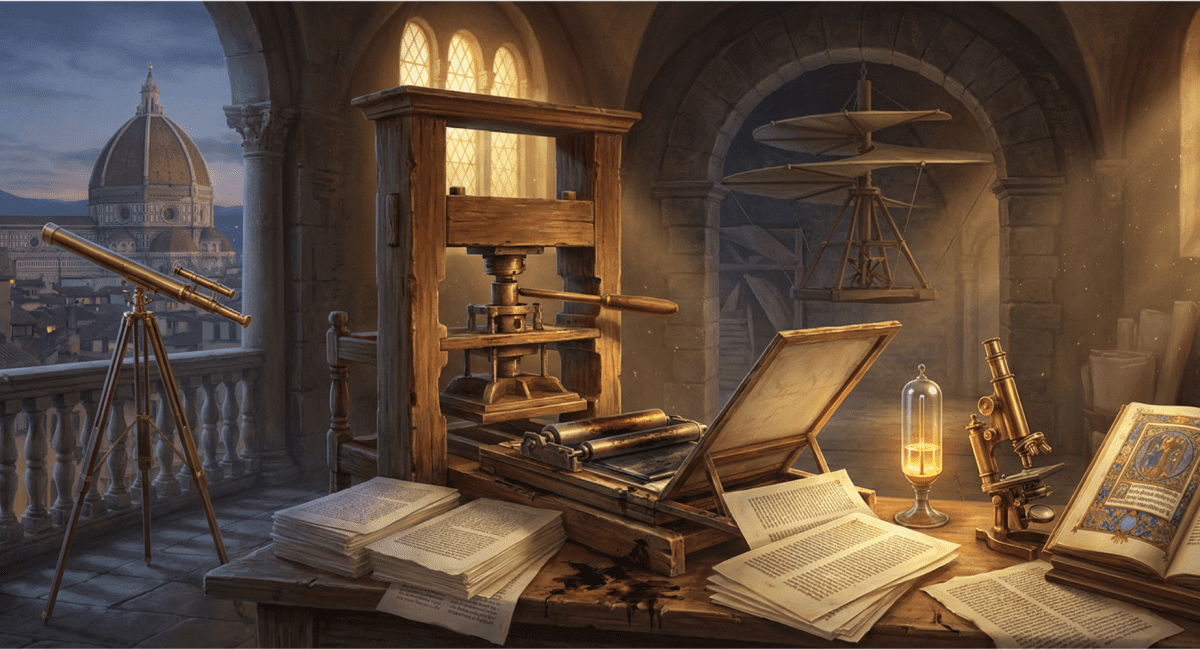
Imagine a world without books, glasses, or accurate clocks. That was Europe just before the Renaissance. Then, in roughly 300 years, everything changed.
The Renaissance — running from roughly the 14th to the 17th century — is famous for its art. Michelangelo, da Vinci, Raphael. You know the names. But the era’s real legacy runs much deeper than paint and marble. It’s a story of inventors, engineers, and curious minds who rewrote the rules of what was possible.
These Renaissance inventions didn’t just improve daily life. They topple the Church’s grip on information, unlock the secrets of the cosmos, and set the stage for modern science. Some are practical tools. Others are wild ideas that take centuries to build. A few are downright odd. All of them matter.
Here are 16 Renaissance inventions that changed the world — including two that most history lists completely ignore: the anemometer and the revolving stage.
- The Printing Press
- Linear Perspective in Art
- The Scientific Method
- The Telescope
- The Thermoscope
- The Anemometer
- The Pencil
- The Pocket Watch
- The Double Shell Dome
- The Parachute
- The Aerial Screw
- The Compound Microscope
- The Revolving Stage
- Metallurgical Advancements
- Corrective Eyeglasses
- The Flush Toilet
The Printing Press (c. 1440)
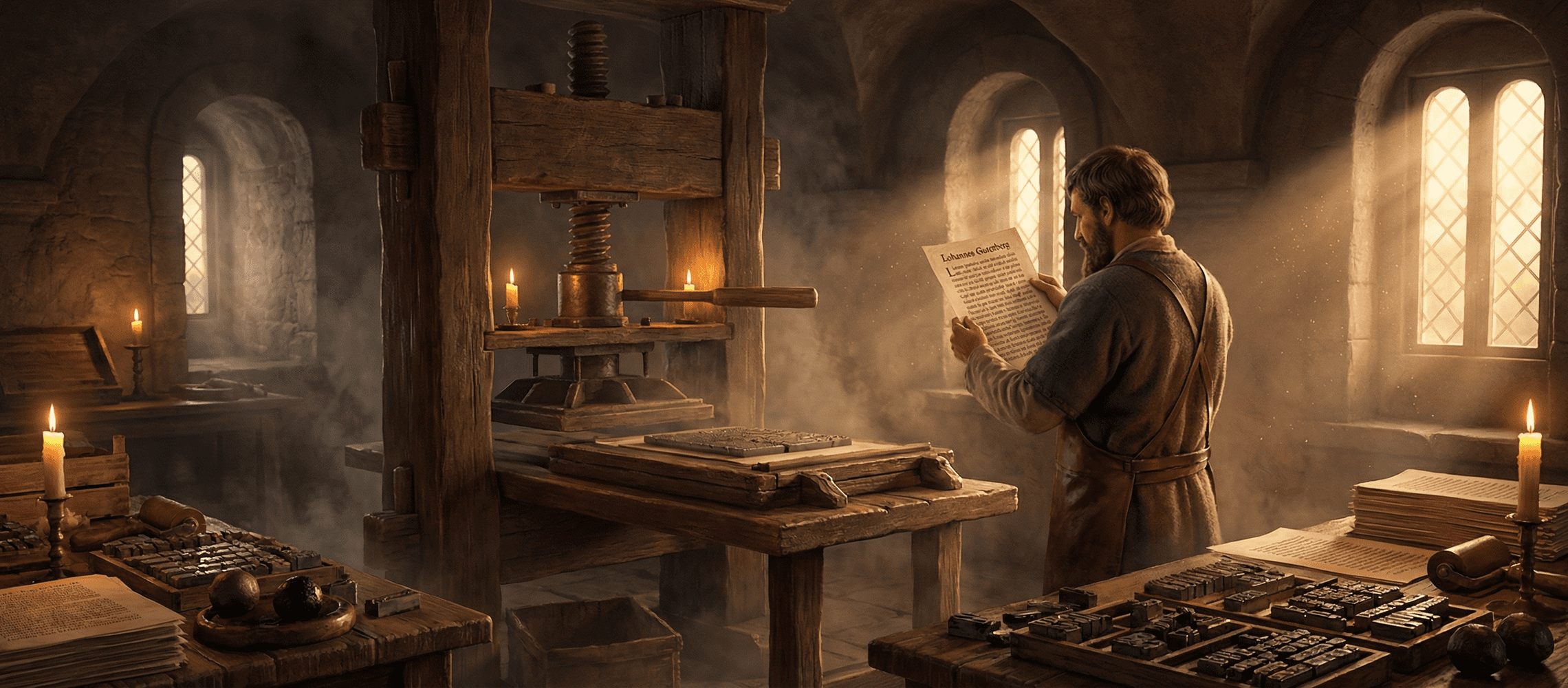 Johannes Gutenberg’s printing press — the invention that broke the Church’s monopoly on information.
Before Johannes Gutenberg invents the printing press around 1440, books are handwritten by monks. One Bible takes years to copy. Only the wealthy and the clergy can own one. Knowledge, in other words, is a closed club.
Gutenberg changes that forever. His press uses movable metal type to stamp ink onto paper at a speed no human hand can match. Within 50 years of its invention, over 20 million books circulate across Europe. The price of books collapses. Literacy climbs. And suddenly, people who have never read anything are holding ideas in their hands.
The Press That Started a Revolution
The effects go way beyond reading. Printed pamphlets spread Martin Luther’s challenges to the Catholic Church faster than any authority can suppress them. Scientists share discoveries across borders. New ideas about astronomy, medicine, and government reach audiences in months rather than decades.
The printing press doesn’t just spread information — it democratizes it. That single shift makes nearly every other item on this list possible. It is, without question, the most consequential of all Renaissance inventions.
Invention No. 2Linear Perspective in Art (c. 1400)
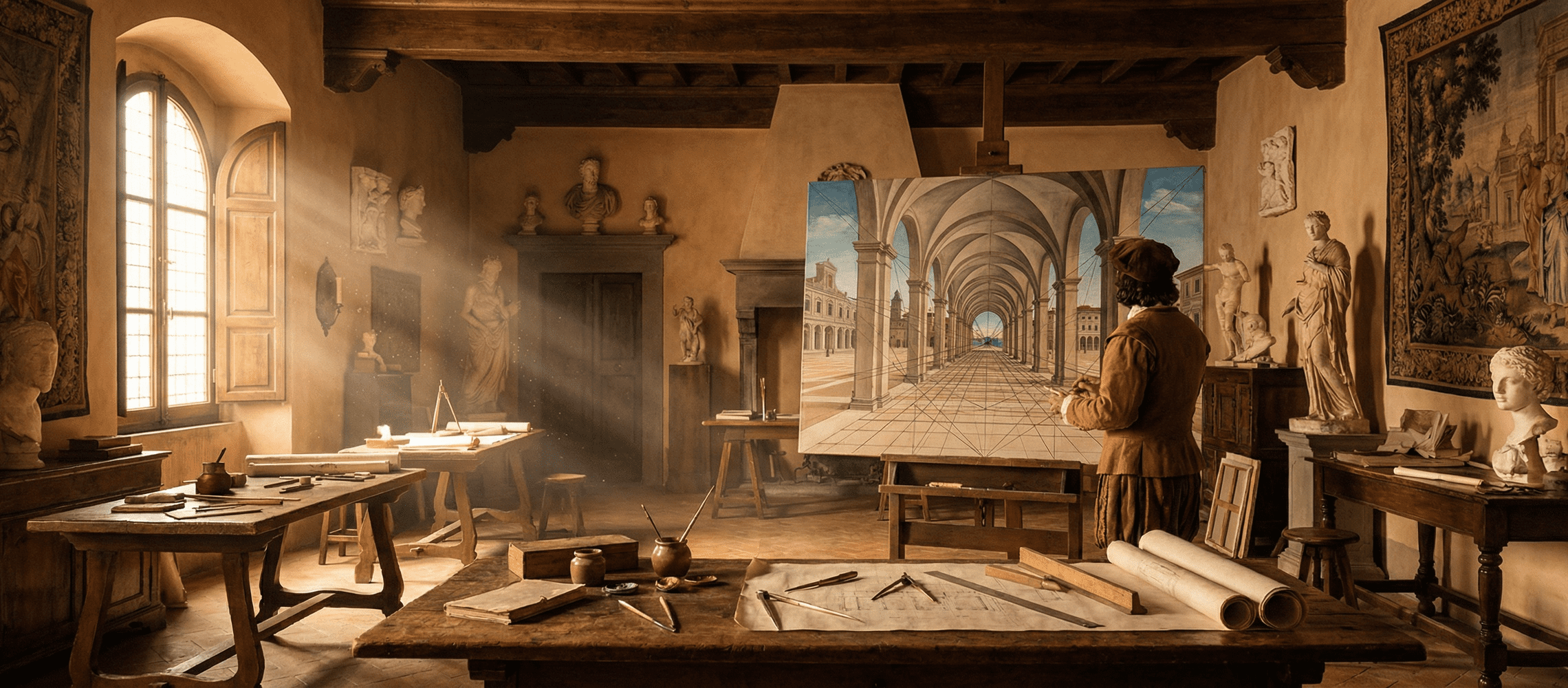 Masaccio’s ‘The Holy Trinity’ (c. 1427) — one of the first paintings to use linear perspective to create a convincing sense of depth.
Look at a medieval painting and you’ll notice something strange. The figures look flat. Buildings appear at odd angles. There’s no real sense of depth. Artists of the time simply don’t have the tools to paint space the way we actually see it.
That changes in early 15th-century Florence. Architect Filippo Brunelleschi figures out the mathematics of how parallel lines appear to converge at a single vanishing point on the horizon. Leon Battista Alberti writes it all down in a clear system any artist can follow. Suddenly, painters can make a flat wall look like a window into another world.
More Than a Painting Trick
Linear perspective isn’t just an artistic breakthrough — it’s a scientific one. It requires precise geometry and careful observation. The same principles influence architecture, engineering, and eventually mapmaking. When Leonardo da Vinci paints The Last Supper, he uses perspective so masterfully that viewers feel physically pulled into the scene. That power starts here, in a Florence workshop, with a mirror and a mathematical idea.
Invention No. 3The Scientific Method (c. 1600)
 Francis Bacon argued that truth comes from evidence and experiment — not from ancient authority.
For most of the Middle Ages, if you want to know why the sky is blue or why people get sick, you consult ancient texts. Aristotle said it. The Church confirmed it. End of discussion. This approach doesn’t just slow science down — it stops it entirely for centuries.
Then thinkers like Galileo Galilei and Francis Bacon come along and propose something radical. Don’t just trust old books. Watch. Test. Measure. Record what actually happens and build your conclusions from evidence. That process — observation, hypothesis, experiment, conclusion — is what we now call the scientific method.
The Foundation of Modern Knowledge
Galileo uses a ramp and a ball to disprove Aristotle’s claim that heavier objects fall faster. Bacon writes Novum Organum in 1620, laying out the case for inductive reasoning. Together, they make a simple but earth-shaking argument: authority doesn’t make something true. Evidence does. Every scientific discovery made since — every vaccine, every space mission, every medical treatment — flows directly from this Renaissance idea.
Invention No. 4The Telescope (c. 1608)
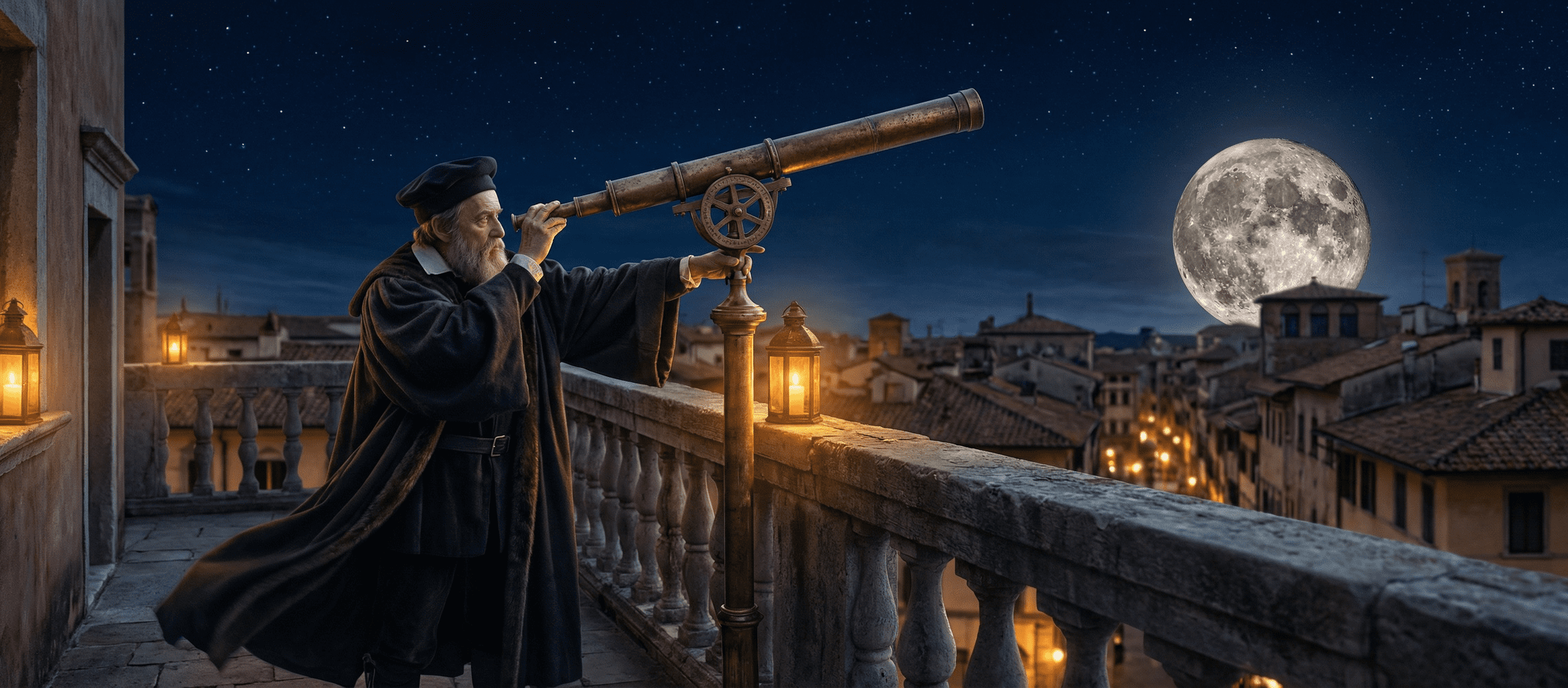 Hans Lippershey’s telescope gave humanity its first close look at the cosmos — and shattered a thousand years of assumptions.
Dutch lens maker Hans Lippershey patents the first telescope in 1608. He designs it to spot enemy ships. Within a year, Galileo points a much-improved version at the night sky — and everything humans think they know about the universe starts to unravel.
Galileo sees mountains on the Moon. He spots four moons orbiting Jupiter. He observes that Venus goes through phases, just like our Moon. Each discovery chips away at the ancient idea that Earth sits motionless at the center of the cosmos. The telescope doesn’t just extend human sight. It forces an entirely new understanding of our place in the universe.
A Tool That Changed Philosophy
The Church initially resists these findings hard. Galileo spends the last years of his life under house arrest for backing the heliocentric model. But the telescope’s evidence is impossible to ignore forever. It triggers the Scientific Revolution and plants the seed for every space mission, satellite, and observatory that follows. All from a tube with two pieces of glass.
Invention No. 5The Thermoscope (c. 1606)
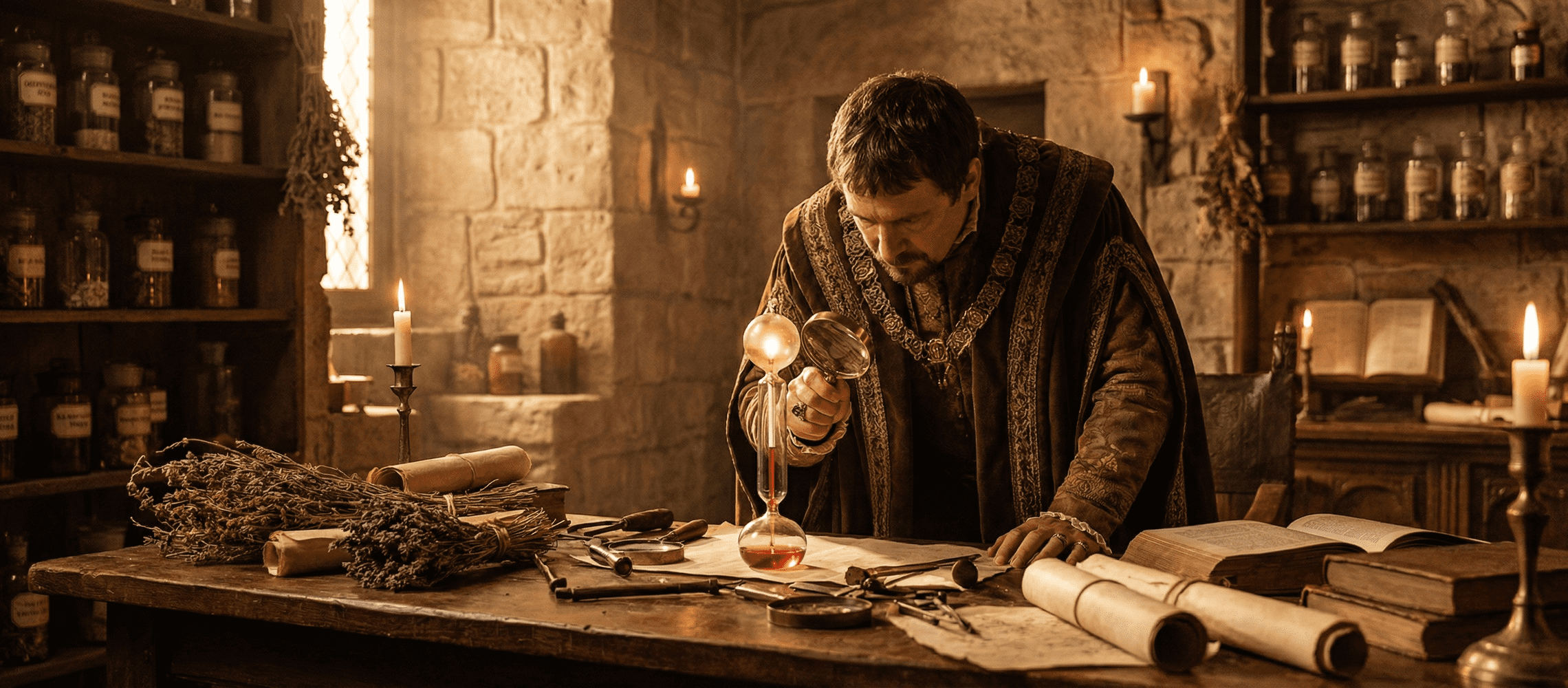 Galileo’s thermoscope — the first device to show temperature changes, and the ancestor of every thermometer since.
Galileo strikes again. Around 1606, he invents the thermoscope — a glass tube with a bulb at one end that shows temperature changes by the rising and falling of liquid inside. It has no scale. You can’t give an exact number. But you can tell, for the first time, whether something is hotter or cooler than before.
Santorio Santorio, an Italian physician and friend of Galileo, takes the device further. He adds a scale to it, turning the thermoscope into something closer to an actual thermometer. He even uses it to measure his patients’ body temperature — a remarkable idea for medicine at the time.
The First Step Toward Precision Science
The thermoscope matters because it represents a new way of thinking. Instead of describing temperature in vague terms like “hot” or “feverish,” scientists begin to measure it. That shift toward hard data is at the heart of modern science. Gabriel Fahrenheit and Anders Celsius are still a century away, but the thermoscope sets them up perfectly. Among Renaissance inventions, this one quietly changes how humans understand the physical world.
Invention No. 6The Anemometer (c. 1450)
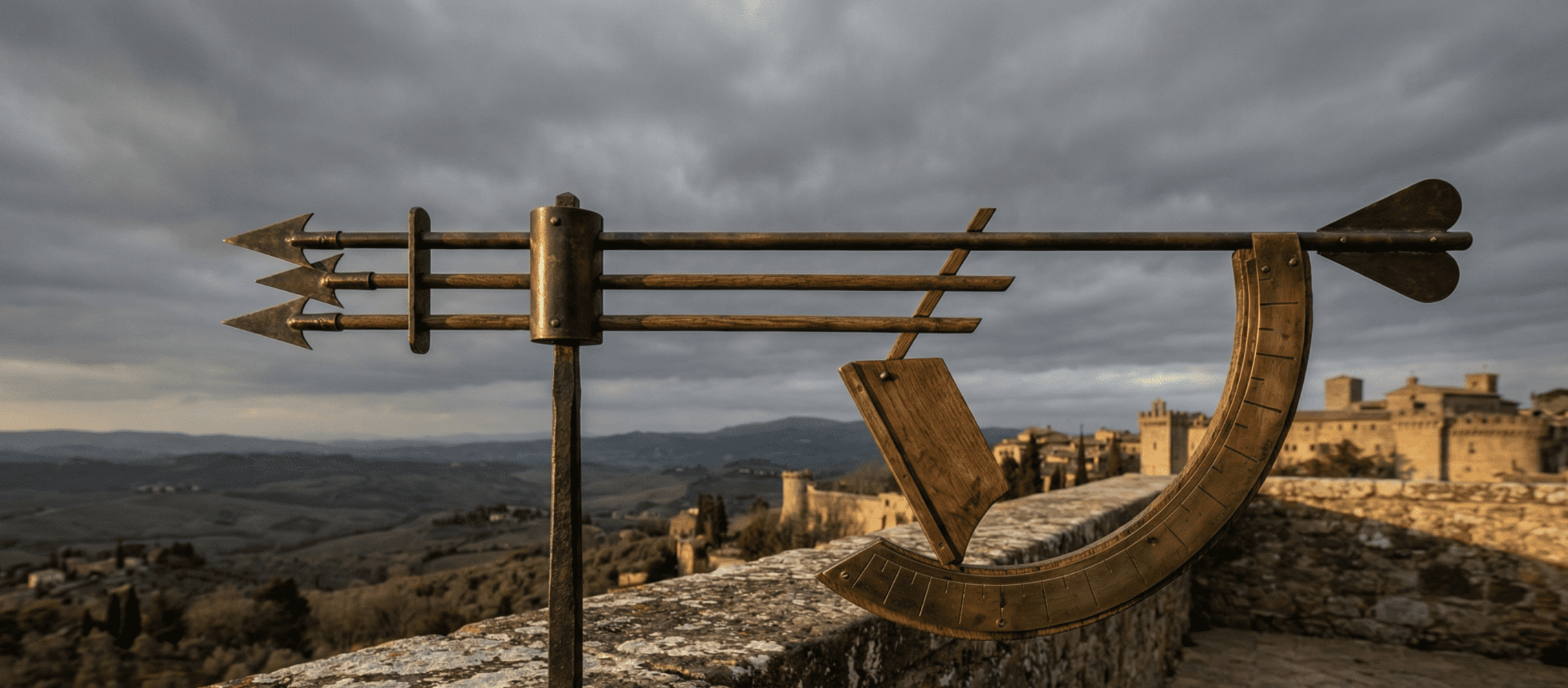 Leon Battista Alberti’s anemometer — the first mechanical device to measure wind speed, and the foundation of modern meteorology.
Leon Battista Alberti is one of those Renaissance figures who seems to have done everything. He’s an architect, a painter, a poet, a philosopher — and around 1450, he builds the first known mechanical anemometer, a device for measuring wind speed.
His design uses a disc that pivots on an axis. Wind pushes the disc. The angle of tilt tells you how fast the wind is blowing. It’s simple, elegant, and surprisingly accurate for the era. Sailors, farmers, and military commanders all have reasons to want this kind of information.
Roots of Modern Meteorology
The anemometer may not grab headlines the way the telescope does, but it marks the beginning of systematic weather observation. Today’s anemometers — cup-style, laser Doppler, ultrasonic — all trace their lineage back to Alberti’s spinning disc. Renaissance inventions don’t get more underrated than this one.
Invention No. 7The Pencil (c. 1560s)
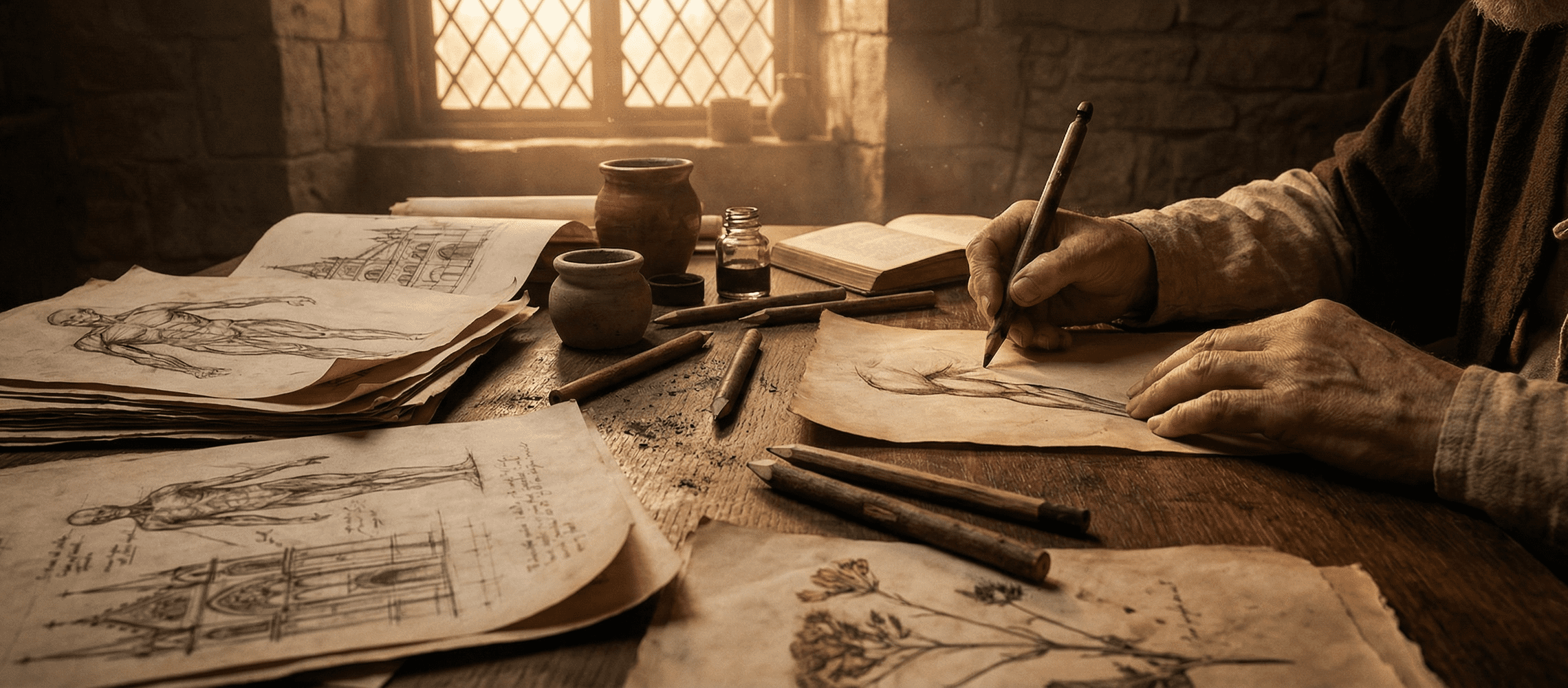 From Renaissance workshops to your desk drawer — the pencil has been the artist’s and scientist’s tool of choice for over 450 years.
In the 1550s, a large deposit of graphite is discovered near Borrowdale in Cumbria, England. People quickly realize you can use it to mark paper. The problem is that it’s messy — it smears everywhere and crumbles in your hands.
Italian couple Simonio and Lyndiana Bernacotti are often credited with solving this problem in the 1560s by inserting a graphite stick into a hollowed-out piece of juniper wood. The pencil is born. It’s cheap, erasable, and works on nearly any surface. Artists, architects, and scientists grab it immediately.
The Tool Behind the Ideas
Think about what the pencil makes possible. Thinkers of the era fill thousands of notebook pages with sketches of flying machines, human anatomy, and engineering designs. The pencil is the original tool for thinking out loud. Among Renaissance inventions, it’s easy to overlook precisely because it’s so familiar. Don’t overlook it.
Invention No. 8The Pocket Watch (c. 1505)
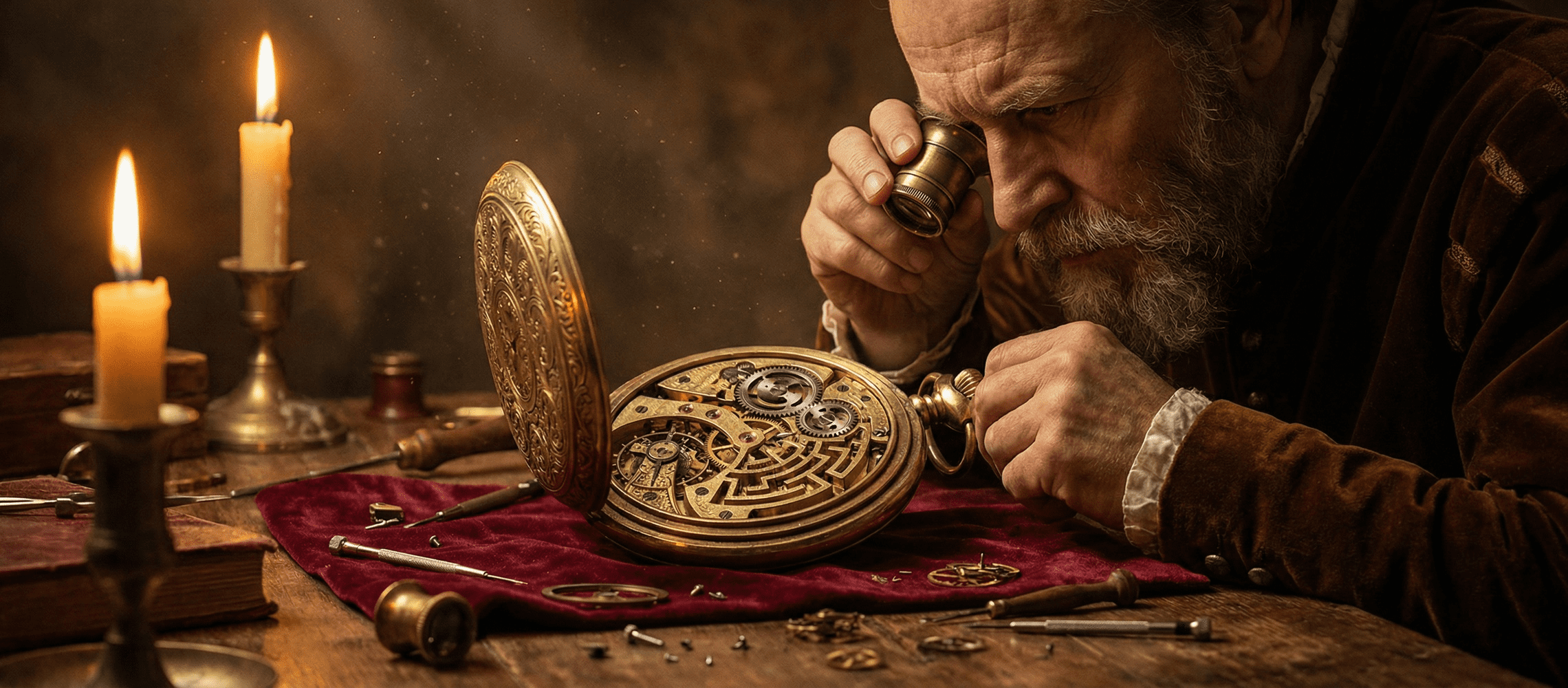 Peter Henlein’s pocket watch put time in the hands of the individual — and changed how people organized their lives.
Before the pocket watch, you tell time by looking at a tower clock in the town square. Time is public property. Then around 1505, German clockmaker Peter Henlein miniaturizes the spring-driven clock into something small enough to wear on your person. Suddenly, time belongs to the individual.
These early watches aren’t precise by modern standards — they gain or lose hours per day. But that’s beside the point. For the first time, a merchant or a ship’s captain can carry their own timepiece. Personal schedules become possible. Punctuality becomes a concept. The whole modern idea of managing your time begins here.
Navigation and Status Combined
The pocket watch also plays an important role in sea navigation. Sailors need to track time accurately to estimate their position at sea. While early pocket watches aren’t reliable enough for exact longitude calculations, they push clockmakers toward ever-greater precision. That drive eventually produces the marine chronometer — which finally solves the longitude problem and makes global navigation safe. It all starts with Henlein’s little spring-powered egg.
Invention No. 9The Double Shell Dome (c. 1436)
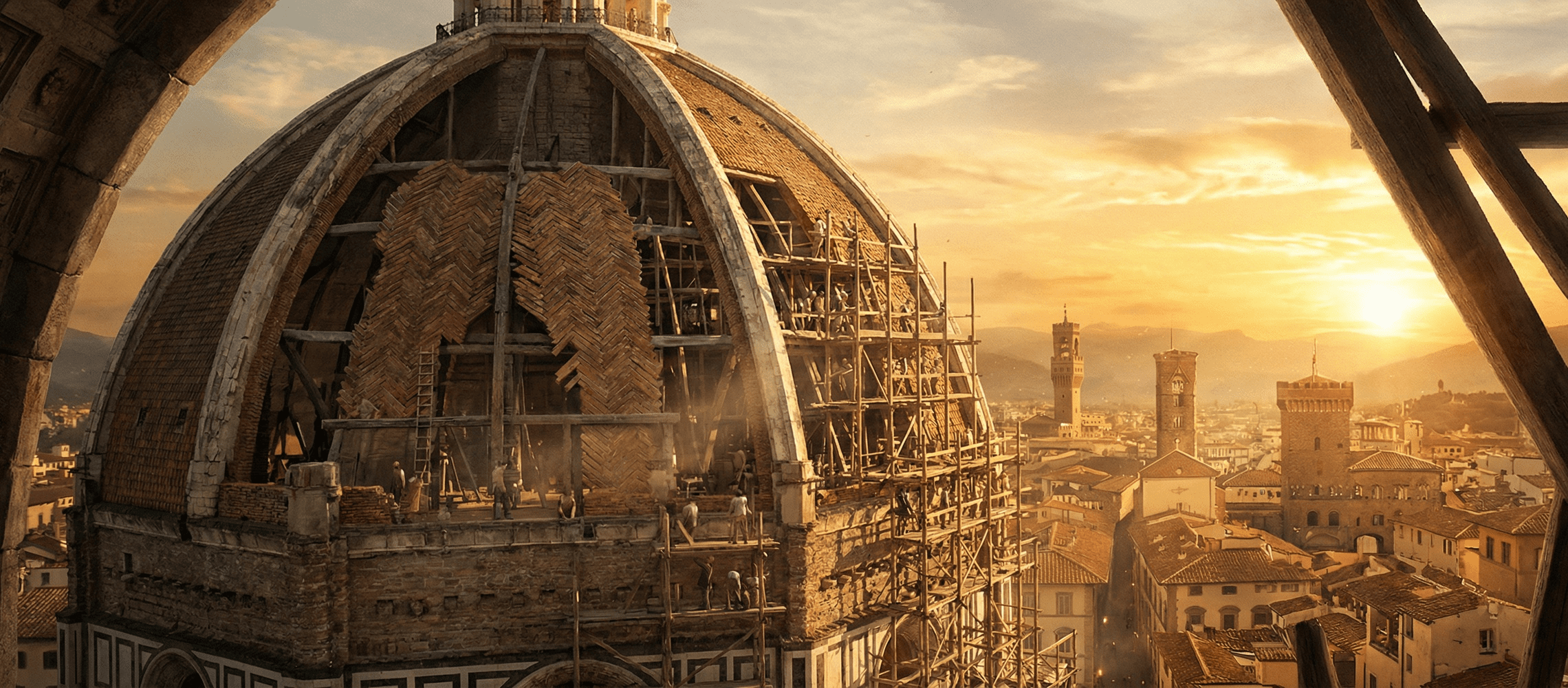 Brunelleschi’s dome over the Florence Cathedral — built without scaffolding, defying every convention of medieval architecture.
Here’s the challenge Filippo Brunelleschi faces in 1418: Florence Cathedral has a massive octagonal hole in its roof, 143 feet across, sitting open for over a century. Nobody knows how to cover it. Traditional Gothic domes require enormous wooden scaffolding — but there isn’t enough timber in Tuscany to build it. The dome sits unfinished, embarrassing the most ambitious city in Europe.
Brunelleschi’s solution is brilliant and strange. He proposes building two separate shells — an outer dome for aesthetics and an inner dome for structural strength — tied together with a system of ribs and rings. He also invents new hoisting machines to lift materials without scaffolding. The whole thing goes up like a three-dimensional puzzle, each ring of bricks locking the one below it in place.
An Engineering Marvel That Still Stands
The Florence Cathedral dome is completed in 1436 and remains the largest masonry dome ever built. It influences architects for the next 600 years — including Michelangelo, who studies it carefully before designing St. Peter’s Basilica in Rome. Among Renaissance inventions, this one is the most visible. You can still see it today, rising over the Florence skyline, exactly as Brunelleschi imagines it.
Invention No. 10The Parachute (c. 1485)
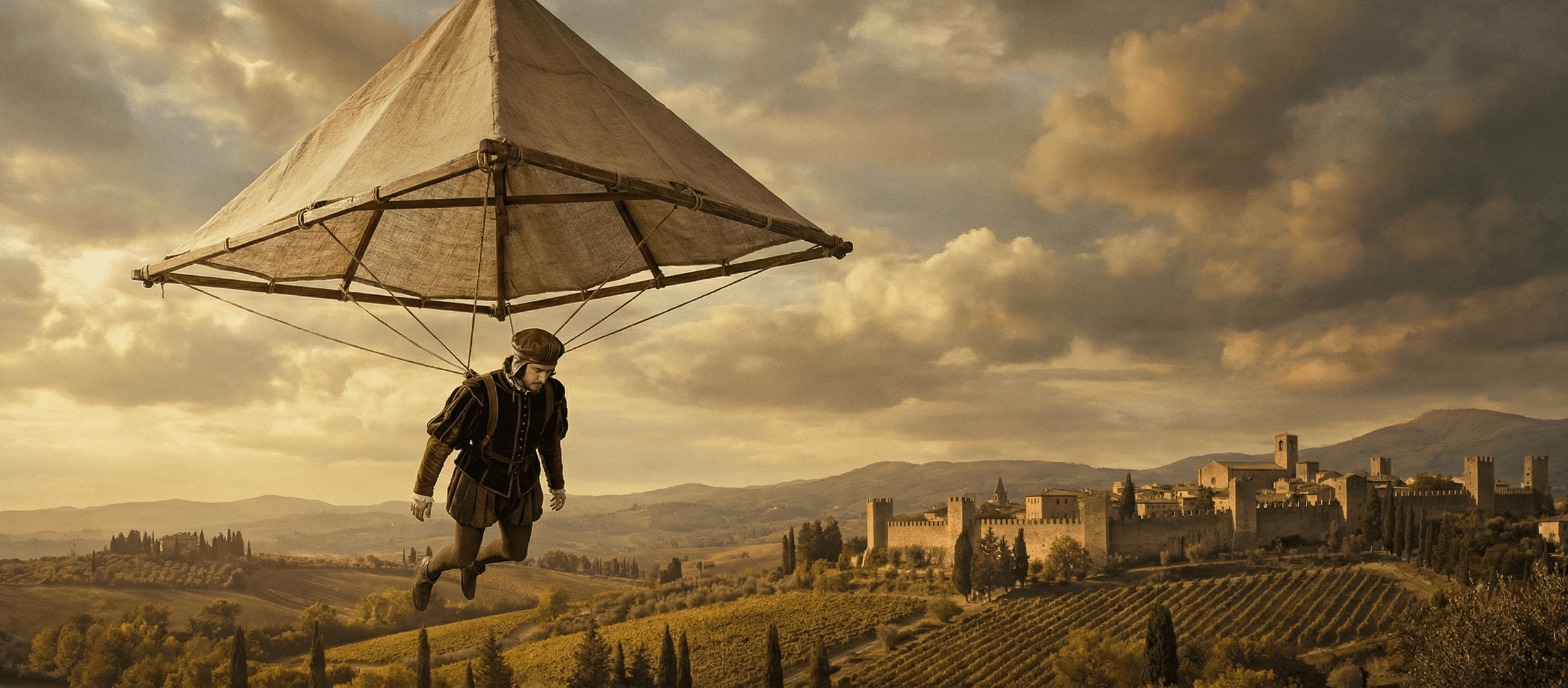 Da Vinci’s parachute sketch from the Codex Atlanticus — tested and proven functional by skydiver Adrian Nicholas in 2000.
In his notebooks around 1485, Leonardo da Vinci sketches a pyramidal canopy made of sealed linen, wide enough to slow a person’s fall from any height. He writes that it would allow a man to jump from great heights “without any injury.” He never builds it. For 500 years, most people assume it wouldn’t have worked anyway.
Then in 2000, skydiver Adrian Nicholas builds a replica of da Vinci’s exact design and jumps from 10,000 feet. It works. Perfectly. Leonardo is right — half a millennium before anyone tests the idea.
Da Vinci’s Gift to the Future
The parachute is a perfect symbol of how Renaissance inventions work. The technology to build and test it doesn’t exist yet. The concept, however, is fully formed and correct. Da Vinci isn’t just inventing things for his own time. He’s sketching solutions for generations not yet born. That’s what makes him unlike anyone else in the history of Renaissance inventions — or any inventions, for that matter.
Fascinated by da Vinci? Check out our deep-dive: Renaissance Master: 10 Intriguing Facts About Leonardo da Vinci
The Aerial Screw / Proto-Helicopter (c. 1489)
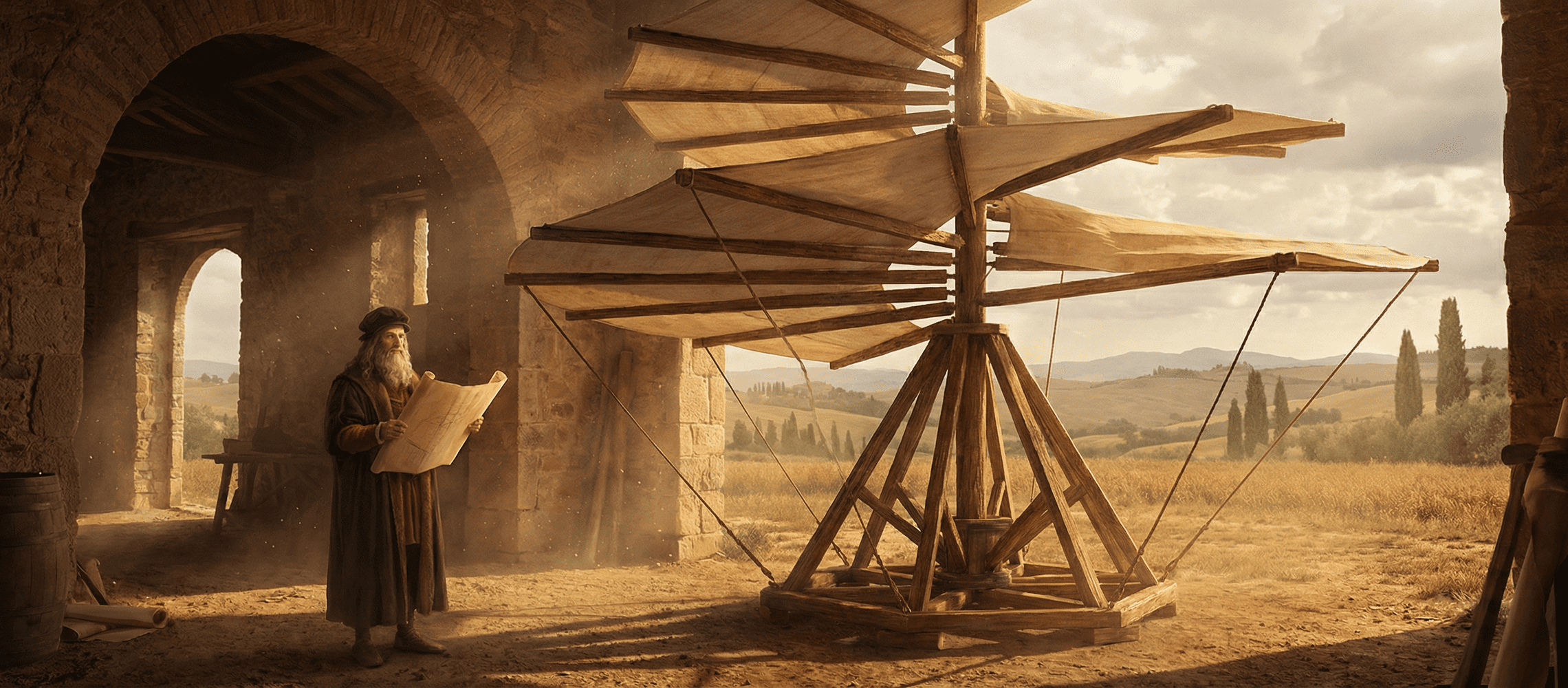 Da Vinci’s aerial screw — the concept behind the modern helicopter, sketched nearly 400 years before one was ever built.
Around 1489, da Vinci sketches a machine with a large helical screw — like a giant corkscrew — designed to spin fast enough to compress air and lift the whole contraption off the ground. Four men stand on a platform below, turning cranks to spin it. He calls it the “aerial screw.” We’d call it a helicopter.
It almost certainly wouldn’t have flown. The human-powered mechanism can’t generate enough torque, and the craft has no way to control direction. Da Vinci himself may have understood this. But the core idea — using rotating blades to generate vertical lift — is exactly right.
The Idea That Waited 400 Years
Igor Sikorsky builds the first practical helicopter in 1939. When he discusses the history of his invention, he acknowledges da Vinci’s sketch as an early inspiration. That’s a 450-year gap between concept and reality. The aerial screw may be the longest-delayed of all Renaissance inventions — and one of the most remarkable examples of a mind working centuries ahead of its time.
Invention No. 12The Compound Microscope (c. 1590)
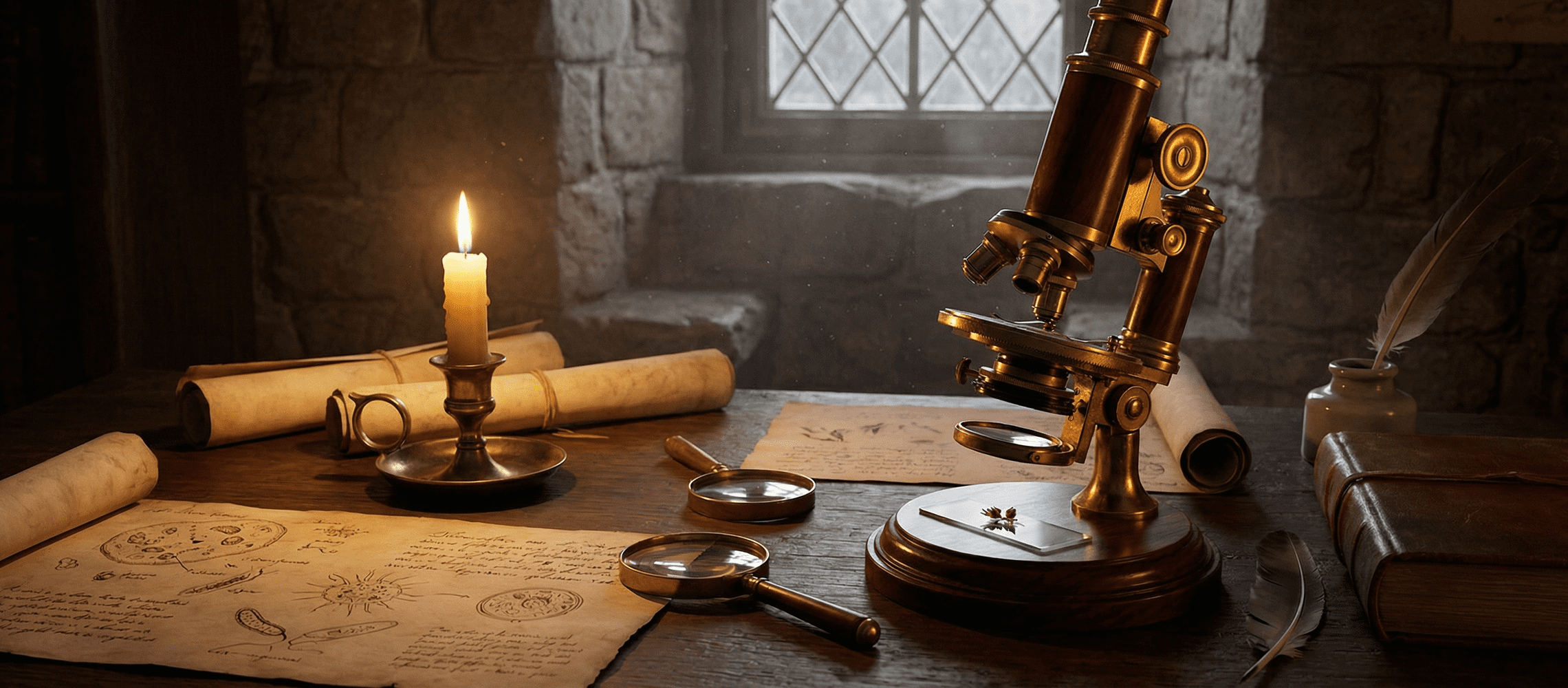 Zacharias Janssen’s compound microscope opened up an entirely invisible world — and launched modern biology and medicine.
Dutch spectacle-maker Zacharias Janssen and his father Hans are believed to have built the first compound microscope around 1590. The device stacks two lenses in a tube — one to capture the image, one to magnify it further. The result: objects appear 20 to 30 times larger than the naked eye can see.
At first, people mostly use it to look at insects and small objects. The real power of the compound microscope takes a few more decades to sink in. But once it does, it’s transformative. Scientists discover that the human body contains cells. They find microorganisms invisible to the naked eye. They begin to understand that disease has physical, observable causes.
The Invention That Built Modern Medicine
The compound microscope is arguably the most life-saving of all Renaissance inventions. Without it, germ theory is impossible. Without germ theory, modern medicine — antibiotics, surgery, vaccines, public health — never develops. Every time a doctor identifies an infection or a biologist studies a cell, they’re working in a tradition that starts in a Dutch spectacle shop in the late 16th century.
Invention No. 13The Revolving Stage (c. 1600)
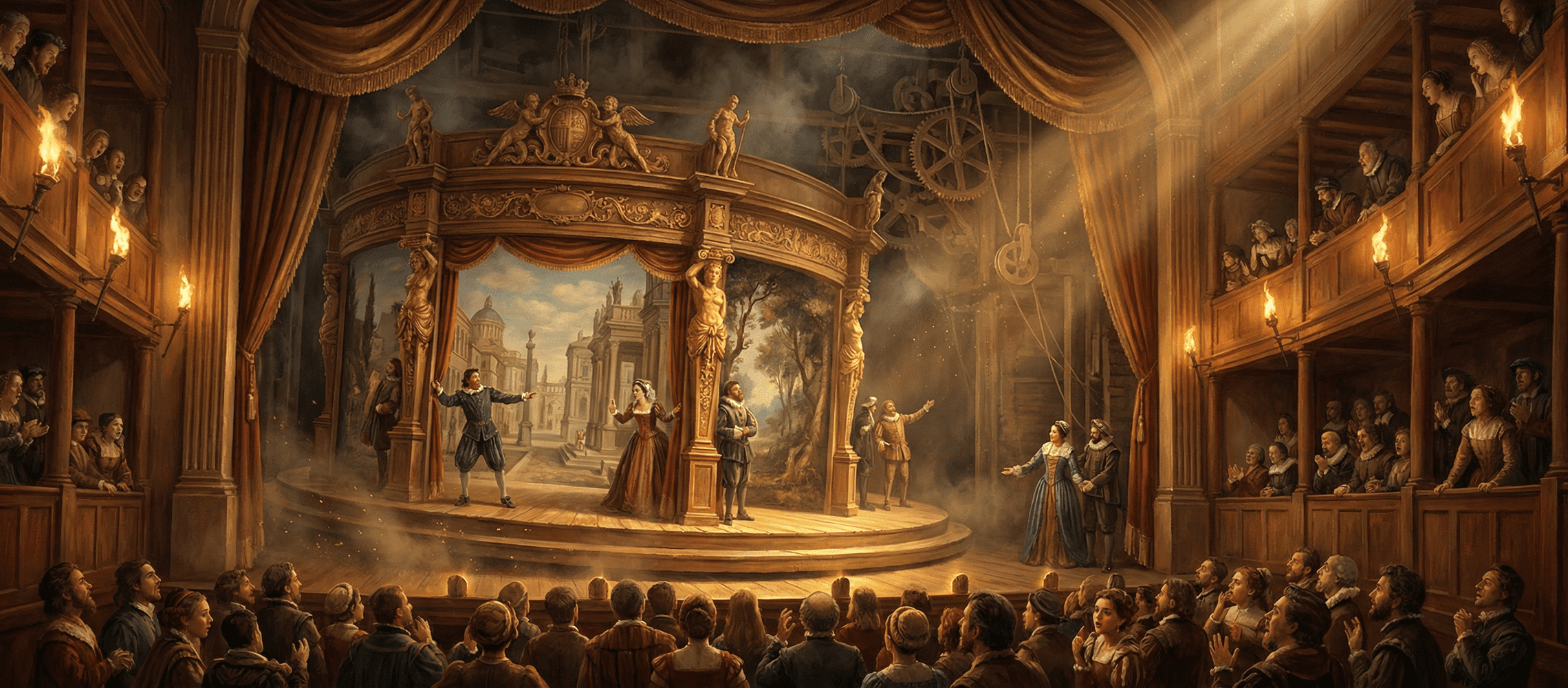 The revolving stage — born in Renaissance Italy, still spinning in theaters worldwide today.
Renaissance theater isn’t just about words. Italian theatrical designers of the 16th century develop elaborate machinery — trap doors, flying rigs, painted backdrops — to create spectacular visual effects. Among the most clever of these Renaissance inventions is the revolving stage.
The concept is simple. Build the stage on a rotating platform. Spin it between scenes, and you can present a completely different set without the audience leaving their seats. What takes a crew of stagehands 20 minutes to rearrange now happens in seconds. The drama never stops.
Still Spinning Today
The revolving stage spreads from Italy across Europe during the Baroque period and becomes a standard feature in major theaters. Today, productions like Les Misérables and countless opera houses still use revolving stages to create seamless scene transitions. It’s one of those Renaissance inventions so embedded in modern life that nobody thinks to ask where it came from.
Invention No. 14Metallurgical Advancements (14th–17th century)
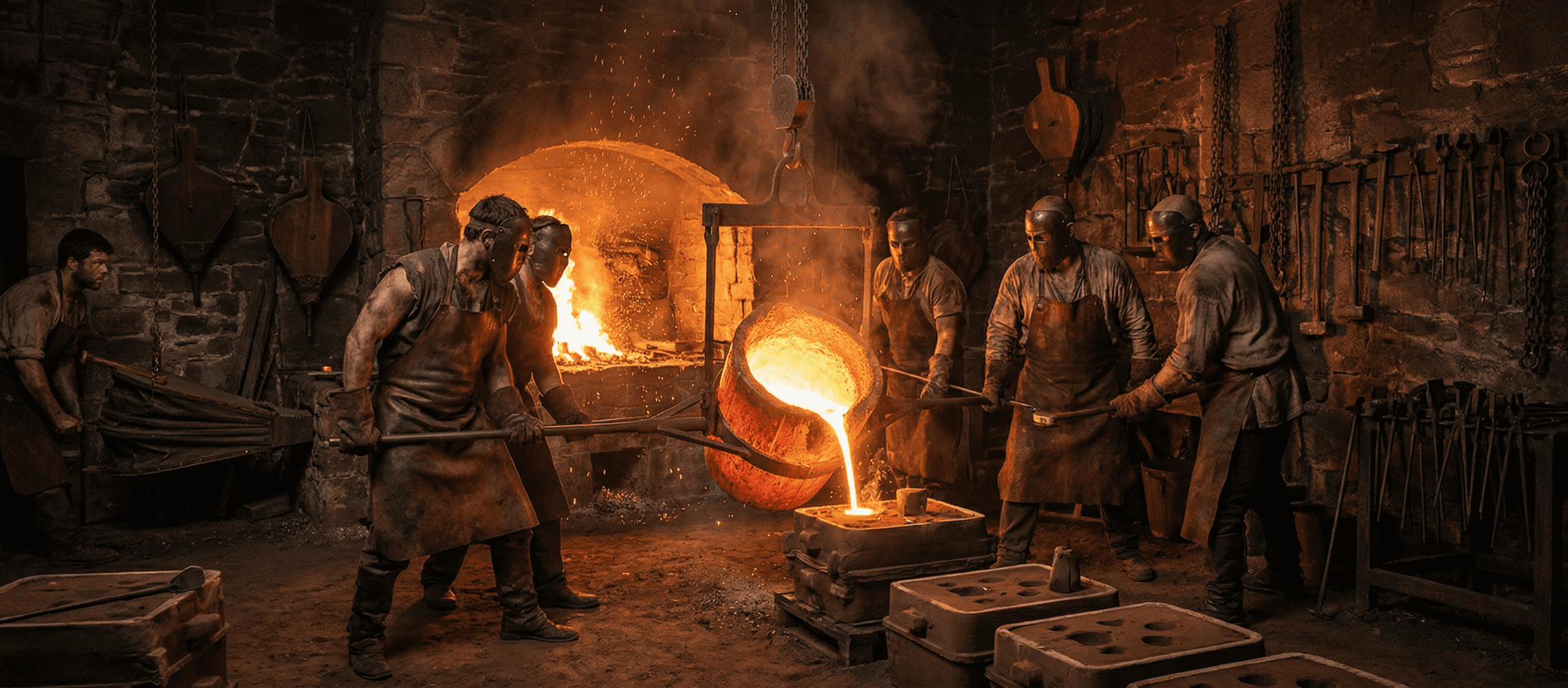 Better metals meant better weapons, stronger buildings, and more reliable coinage — the quiet revolution behind the Renaissance.
Not every Renaissance invention has a single inventor or a precise date. The era’s metallurgical advances are a broad, ongoing process — but no less revolutionary for it. Improved smelting techniques produce purer iron and stronger steel. New alloying methods create metals with specific properties. Better furnaces run hotter and more consistently.
The effects ripple across every part of Renaissance society. Stronger metals mean more durable weapons and armor. Better iron makes possible the printing press, precision clockwork, and Brunelleschi’s hoisting machines. Improved coinage from purer metals stabilizes trade across Europe.
The Silent Engine of the Renaissance
The mining engineering treatise De re metallica (1556) by Georg Agricola remains one of the best windows into Renaissance metalworking. It covers smelting, mining, and chemistry in a detail that isn’t matched for over a century. The metallurgical advances of the Renaissance aren’t glamorous — but they’re the foundation every other Renaissance invention rests on.
Invention No. 15Corrective Eyeglasses (15th century)
 The arrival of corrective lenses in the 15th century extended the productive working lives of scholars, craftsmen, and merchants alike.
Rudimentary magnifying lenses exist before the Renaissance. But it’s in the 15th century that craftsmen develop the first corrective eyeglasses — lenses ground specifically to correct nearsightedness, farsightedness, and age-related vision loss. For the first time, a monk whose eyesight is failing can keep reading. A craftsman who can no longer thread a needle can get back to work.
The timing is not a coincidence. The printing press creates an explosion of written material — and suddenly, millions of people who never needed to read before are trying to read. Demand for eyeglasses surges. Lens-grinding becomes a serious craft. The same optical knowledge that produces corrective lenses eventually produces the microscope and the telescope.
One Invention, Three Discoveries
The connection between eyeglasses, the microscope, and the telescope is direct. All three depend on the same understanding of how curved glass bends light. Corrective eyeglasses come first — and the craftsmen who learn to grind lenses for them are the same people who eventually figure out what happens when you combine two lenses in a tube. Among Renaissance inventions, eyeglasses are the quiet ancestor of some of the era’s most famous breakthroughs.
Invention No. 16The Flush Toilet (1596)
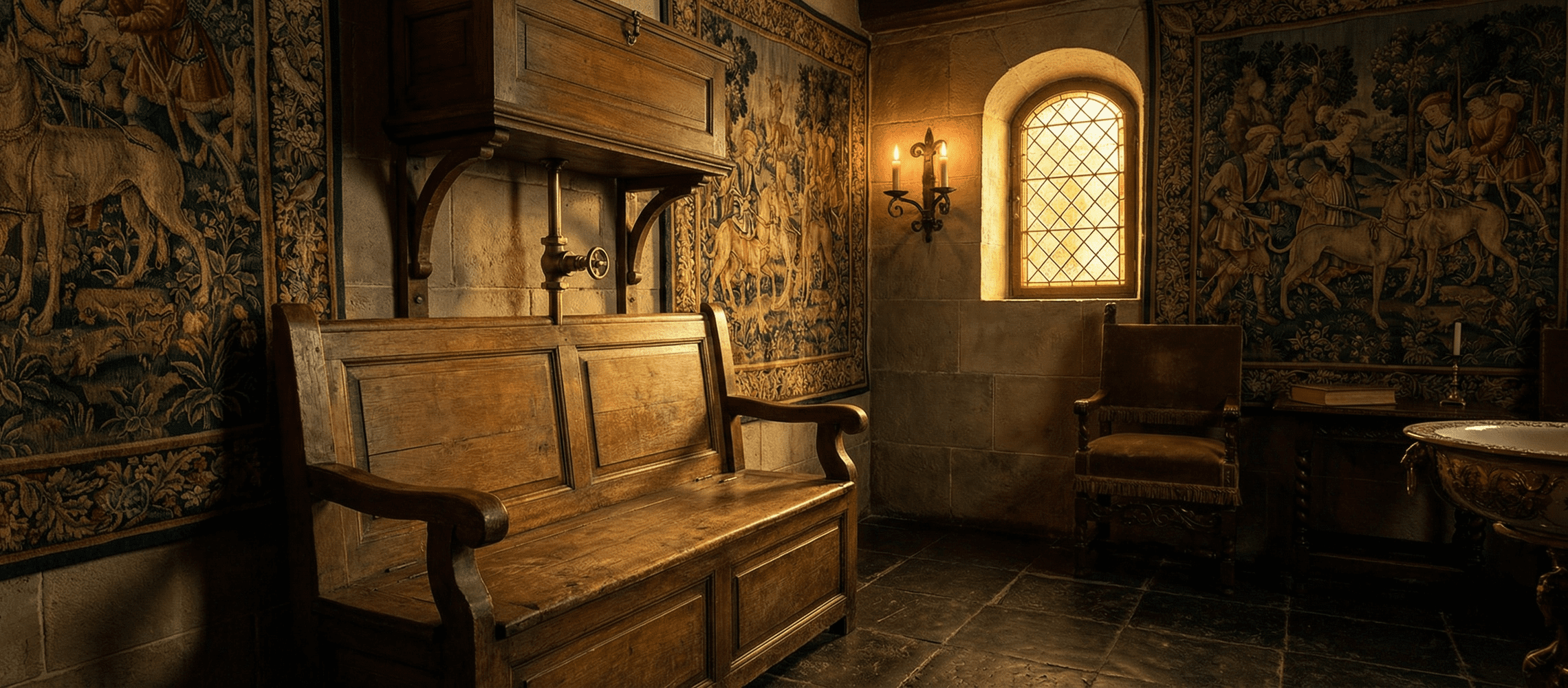 Sir John Harington’s flush toilet — laughed at in 1596, installed in virtually every home on Earth today.
Yes, really. Sir John Harington — poet, courtier, and godson of Queen Elizabeth I — invents the first flush toilet in 1596 and installs one at his home in Kelston, near Bath. He even writes a pamphlet about it, cheekily titled A New Discourse of a Stale Subject, Called the Metamorphosis of Ajax. (“Ajax” is a pun on “a jakes” — Elizabethan slang for a toilet.)
Harington designs a cistern that holds water above the bowl. Pull a valve, and the water flushes the waste through. He installs a second one for Queen Elizabeth at Richmond Palace. Her Majesty, apparently, approves.
200 Years Ahead of His Time
Here’s the cruel irony. Harington’s contemporaries mostly laugh at him. The invention is mocked, ignored, and forgotten. Running water infrastructure doesn’t exist in most cities yet, which makes the flush toilet impractical at scale. It takes another 200 years — and the industrial-era growth of public water systems — before Alexander Cumming patents an improved version in 1775 and the flush toilet becomes widespread.
But Harington gets there first. The least glamorous of all Renaissance inventions is also one of the most important to public health. Cities without effective waste removal are cities full of cholera, typhoid, and dysentery. Harington’s idea, finally put to use at scale, saves more lives than almost anything else on this list.
The Renaissance Invented the Modern World
Step back and look at this list as a whole. The printing press creates an informed public. The scientific method gives that public a way to test what’s true. The telescope and microscope extend human senses into the previously invisible. The pencil, the pocket watch, and eyeglasses reshape daily life. The parachute, the aerial screw, and the flush toilet prove that even ideas taking centuries to catch on are worth having.
These Renaissance inventions aren’t isolated achievements. They’re a connected web of curiosity, observation, and bold thinking that feeds into each other across generations. Brunelleschi’s dome teaches engineers about structural load. His perspective system gives later thinkers the tools to sketch flying machines. The lens-grinders who make eyeglasses eventually produce the microscope. Nothing happens in isolation.
Why It Still Matters
The Renaissance reminds us what a culture looks like when it decides that understanding the world matters more than protecting old assumptions. When you trace the history of inventions across any field — medicine, engineering, astronomy, architecture — the trail leads back here, to these Renaissance inventions and the restless minds behind them. The results, 600 years later, are still all around you.
Which of these Renaissance inventions surprised you most? Drop a comment below — and check out our related articles on the inventors and innovators who shaped history.
Frequently Asked Questions
What were the most important Renaissance inventions?
The printing press stands above the rest. It democratizes information, fuels the Protestant Reformation, and makes nearly every other intellectual advance of the era possible. After that, the scientific method, the telescope, and the compound microscope all rank among the most consequential Renaissance inventions for their long-term impact on science and medicine.
Did Leonardo da Vinci invent the most things during the Renaissance?
Da Vinci produces the most famous designs, but many remain on paper during his lifetime. The printing press, the compound microscope, the telescope, and corrective eyeglasses all have greater immediate impact. Da Vinci’s true strength is in anticipating inventions that later generations actually build — the parachute and the helicopter being the clearest examples.
How did Renaissance inventions affect everyday people?
Deeply and directly. Cheaper books raise literacy rates. Corrective eyeglasses extend working life for craftsmen and scholars. The pocket watch creates the concept of personal time management. Better metallurgy improves tools, weapons, and coins. The flush toilet, eventually, transforms public health. Renaissance inventions don’t just change science — they change how ordinary people live from day to day.
What Renaissance inventions are still used today?
More than you might think. The pencil, eyeglasses, the revolving stage, and the scientific method are all direct descendants of Renaissance originals. The compound microscope and telescope evolve but are unmistakably the same devices. And the flush toilet — delayed by two centuries but eventually triumphant — is in virtually every home on Earth.