
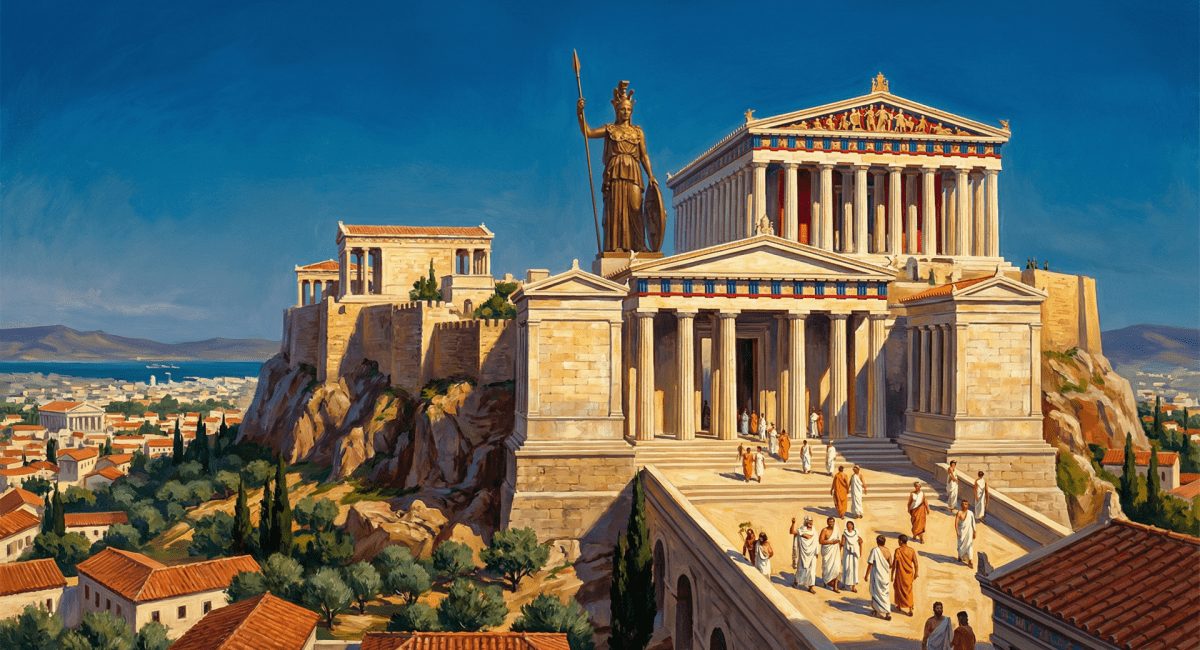
A polis was not simply a city. It was an independent political community — a self-governing state made up of an urban center and the surrounding farmland and villages that fed it. Each polis had its own laws, government, coinage, army, and religious calendar. The citizen body of the polis — not a king or emperor — held ultimate political authority, even in oligarchies. This distinction matters for research: when ancient Greek authors write about a polis, they mean the entire political community, not just the urban core.
The polis emerges as the dominant Greek political form during the Archaic Period (c. 800–480 BC), as Greeks colonize the Mediterranean and Black Sea coastlines and develop the political and cultural institutions that will define Western civilization. At its peak in the Classical Period (480–323 BC), the Greek world contains hundreds of independent poleis — each a sovereign state, each fiercely proud of its autonomy. The Hellenistic Period (323–146 BC) sees these city-states gradually absorbed into larger kingdoms following Alexander’s conquests, ending with Rome’s destruction of Corinth in 146 BC. This list covers all three periods.
This reference page covers the major and historically documented poleis of ancient Greece from approximately 800 BC through 146 BC. It draws on the Copenhagen Polis Centre’s inventory as a baseline — the most comprehensive modern scholarly catalog of ancient Greek city-states — while prioritizing entries with meaningful historical documentation over sheer volume. See our Iron Age Cultures and Periods by Region for the broader context in which the polis form develops, and our Major Battles of the Ancient World for the conflicts that shaped these city-states’ fates. Entries are organized by region, with the Big Four — Athens, Sparta, Corinth, and Thebes — receiving expanded treatment given their outsized role in the historical record.
Athens, Sparta, Corinth & Thebes — Quick Comparison
The four most historically significant poleis compared across five dimensions. For full entries, see the regional tables below.
| Polis | Government | Military Character | Economy | Cultural Contribution | Fate |
|---|---|---|---|---|---|
| Athens | Democracy (from 508 BC); earlier Tyranny under Peisistratos, then mixed oligarchy | Naval superpower; trireme fleet dominates the Aegean; citizen hoplites for land campaigns | Trade, silver mines at Laurion, tribute from Delian League allies | Philosophy (Socrates, Plato, Aristotle), drama (Aeschylus, Sophocles, Euripides), architecture (Parthenon), democracy itself | Defeated by Sparta, 404 BC; recovers; subordinated by Macedon, 338 BC; reduced to a cultural center under Rome |
| Sparta | Mixed — two hereditary kings, an elected council of elders (Gerousia), and five annually elected ephors who held real power; not a democracy | Dominant land army of the ancient Greek world; the Spartiate warrior class trained from age 7 in the agoge | Deliberately non-commercial; iron currency discouraged trade; dependent on helot (serf) agricultural labor | Military discipline and the ideal of sacrifice for the state; the legend of the 300 at Thermopylae; the concept of Laconic speech | Power broken at Battle of Leuctra, 371 BC; declined steadily; absorbed into Achaea League and then Rome |
| Corinth | Oligarchy (after overthrow of Cypselid tyrants, c. 585 BC) | Competent but not dominant; significant naval capacity; founder of Corinthian colonies across the western Mediterranean | Wealthiest commercial polis on the Greek mainland; controlled two seaports (Lechaion and Cenchreae); dominated the Isthmus trade routes | Corinthian pottery (exported across the Mediterranean), Corinthian column order in architecture, early development of the trireme warship | Destroyed by Rome, 146 BC; rebuilt as a Roman colony by Julius Caesar, 44 BC — the continuity of “Corinth” is a genuine historical question |
| Thebes | Oligarchy; controlled by shifting aristocratic factions; briefly democratic under Epaminondas’s influence | Dominant Greek land power 371–362 BC; the Sacred Band (150 pairs of warriors) is one of the most celebrated elite units in ancient history | Agricultural base in the fertile Boeotian plain; less commercially oriented than Athens or Corinth | The Sacred Band; military innovation (oblique order of battle at Leuctra); Pindar, greatest lyric poet of the ancient world, was Theban | Razed by Alexander the Great, 335 BC, after a failed rebellion; survivors sold into slavery; partially rebuilt but never regained significance |
Mainland Greece — Attica, Boeotia, Phocis, Locris & Surroundings
The Greek heartland. Athens dominates politically and culturally; Thebes and Boeotia provide the chief counterweight.
| # | Polis | Region | Modern Location | Government | Peak Period | Notable For | Notes |
|---|---|---|---|---|---|---|---|
| 1 | Athens | Attica | Athens, Greece | Democracy (from 508 BC); earlier Tyranny | 5th–4th c. BC | Democracy, philosophy, arts | Athens is the best-documented polis in the ancient world. Cleisthenes institutes democratic reforms in 508 BC, replacing the tribal system with ten geographic tribes and establishing the Council of 500. The Athenian empire at its height (c. 454–404 BC) extracts tribute from over 150 allied states, funding the Parthenon and the extraordinary cultural output of the golden age. Militarily, Athens is a naval power — its fleet defeats Persia at Salamis (480 BC) and controls Aegean trade routes. The defeat in the Peloponnesian War (431–404 BC) permanently breaks Athenian imperial power, though the city remains the intellectual and cultural center of the Greek world through the Hellenistic period and into Roman times. |
| 2 | Thebes ⚑ NoteCommon misconception — do not confuse with Egyptian Thebes (modern Luxor), a completely unrelated city | Boeotia | Thebes (Thiva), Greece | Oligarchy; brief democratic reforms | 4th c. BC (371–362 BC) | Sacred Band; defeat of Sparta at Leuctra | Distinguish from Egyptian Thebes (modern Luxor) — a completely unrelated city. Boeotian Thebes leads the Boeotian League — a federal alliance of Boeotian poleis — for much of the Classical period. General Epaminondas revolutionizes Greek warfare with the oblique order of battle, crushing Sparta at Leuctra (371 BC) and ending Spartan hegemony. The Sacred Band — 300 warriors organized as 150 pairs — serves as the elite fighting force until destroyed by Philip II of Macedon at Chaeronea (338 BC). Thebes is razed by Alexander the Great in 335 BC following a failed revolt; its population is sold into slavery. Partially rebuilt under Cassander c. 315 BC. |
| 3 | Plataea | Boeotia | Plataea, Boeotia, Greece | Democracy (aligned with Athens) | 5th c. BC | Battle of Plataea (479 BC), decisive Greek victory over Persia | Destroyed by Thebes, 427 BC; rebuilt 386 BC; destroyed again by Thebes, 373 BC; rebuilt after 338 BC by Alexander. |
| 4 | Megara | Megaris | Megara, Greece | Oligarchy; brief Tyranny under Theagenes | 7th–6th c. BC | Prolific colonizer; founded Byzantium and Chalcedon | Megara punches above its weight as a colonial power, founding settlements that control strategic waterways. Its position between Athens and Corinth keeps it perpetually squeezed by larger neighbors. |
| 5 | Orchomenos | Boeotia | Orchomenos, Greece | Oligarchy | Mycenaean era; 6th c. BC | Rival to Thebes; Mycenaean treasury (Treasury of Minyas) | One of the wealthiest Mycenaean centers before 1200 BC. Its rivalry with Thebes for dominance of Boeotia runs through the entire Classical period. |
| 6 | Tanagra | Boeotia | Tanagra, Boeotia, Greece | Oligarchy | 5th c. BC | Battle of Tanagra (457 BC); terracotta figurines | Tanagra figurines — delicate terracotta statuettes produced here — become widely collected in antiquity and give the site enduring archaeological fame. |
| 7 | Delphi | Phocis | Delphi, Greece | Amphictyonic League control; priestly administration | 7th–4th c. BC | Oracle of Apollo; pan-Hellenic religious center | Technically a sanctuary settlement more than a standard polis, but included here as it functions as an independent political and religious entity. The Delphic Oracle shapes Greek foreign policy for centuries. |
| 8 | Amphissa | Locris (Ozolian) | Amfissa, Greece | Oligarchy | 4th c. BC | Triggered the Fourth Sacred War; leading Locrian polis | The Amphissean seizure of Delphic sacred land in 339 BC triggers the Fourth Sacred War, giving Philip II of Macedon his pretext for intervention in central Greece. |
| 9 | Chalcis | Euboea | Chalcis (Chalkida), Greece | Oligarchy; Tyranny at intervals | 8th–7th c. BC | Major colonizer; Chalcidic peninsula named for it | One of the earliest and most active Greek colonizers — Chalcidian settlers establish cities across Sicily, the Chalcidice peninsula, and southern Italy in the 8th–7th centuries BC. |
| 10 | Eretria | Euboea | Eretria, Greece | Oligarchy | 8th–6th c. BC | Burned by Persians, 490 BC; Lelantine War with Chalcis | Eretria’s burning by the Persian fleet in 490 BC — before Marathon — makes it one of the first Greek cities to feel Persian wrath. Its population is deported to Persia. |
The Peloponnese — Laconia, Argolis, Corinthia, Achaea & Elis
Sparta’s home territory — and home to some of its most persistent rivals.
| # | Polis | Region | Modern Location | Government | Peak Period | Notable For | Notes |
|---|---|---|---|---|---|---|---|
| 11 | Sparta (Lacedaemon) LegendPopular belief has grown beyond what sources actually support — read the Notes column carefully | Laconia | Sparta (Sparti), Greece | Mixed — dual kingship, Gerousia, Ephors | 6th–4th c. BC | Dominant land army of the ancient Greek world | Official ancient name: Lacedaemon. “Sparta” refers to the principal urban settlement; “Lacedaemon” is the state. The legendary warrior culture — the agoge (total military upbringing from age 7), the Spartiate warrior class, the famous “Come back with your shield or on it” — is substantially historical, though it is also heavily mythologized in later Athenian and Roman sources. LegendThe “300 at Thermopylae” is historically attested but culturally inflated — Sparta also sent allied troops, and the battle’s symbolic weight grew dramatically in later tradition The “300 at Thermopylae” story is historically attested but culturally inflated: Sparta also sent thousands of allied troops, and the battle’s significance was strategic rather than the symbolic last stand it becomes in later tradition. Sparta’s power rests on helot labor — a enslaved agricultural population of perhaps 7 Helots per Spartan citizen. Power broken by Thebes at Leuctra, 371 BC; never recovers hegemony. |
| 12 | Corinth | Corinthia | Ancient Corinth, Greece | Oligarchy (after Cypselid tyrants) | 7th–5th c. BC | Wealthiest commercial polis on the mainland | Corinth’s geographic position — controlling the Isthmus of Corinth with ports on both the Saronic Gulf (Cenchreae) and Corinthian Gulf (Lechaion) — makes it the wealthiest trading polis on the Greek mainland. Ships are dragged overland on a stone trackway (the diolkos) to avoid the dangerous Cape Malea route. Corinth develops the trireme warship and exports its distinctive pottery across the Mediterranean. Destroyed by the Roman general Lucius Mummius in 146 BC — the same year Rome destroys Carthage — in a deliberate act of power projection. Rebuilt as the Roman colony Colonia Laus Iulia Corinthiensis by Julius Caesar in 44 BC. ⚑Historically contested — whether Roman Corinth (44 BC) is continuous with Greek Corinth (destroyed 146 BC) is debated among classicists Whether this Roman Corinth constitutes continuity with the Greek polis or a new entity is debated among classicists. |
| 13 | Argos ⚑Historically contested — Argos’s claim to be older than Sparta appears in ancient sources but is archaeologically ambiguous | Argolis | Argos, Greece | Democracy (from early 5th c. BC) | 7th c. BC; 5th c. BC | Ancient rival of Sparta; claim to oldest polis status | Ancient sources (Thucydides included) credit Argos with great antiquity — possibly the oldest continuously inhabited Greek city. ⚑Historically contested — Argos’s claim to be the oldest Greek city appears in primary sources but lacks definitive archaeological confirmation Archaeologically contested; the claim is not settled. Argos defeats Sparta at the Battle of Hysiae (669 BC) — one of Sparta’s rare early defeats — then declines as Sparta consolidates Laconia. Argos remains stubbornly independent and neutral during the Persian Wars, a fact Athens and Sparta both resent. |
| 14 | Olympia | Elis | Olympia, Greece | Priestly / Elean administration | 8th–4th c. BC | Site of the Olympic Games (from 776 BC) | A sanctuary site rather than a polis in the standard sense, but administered as an independent entity by the Eleans. The Olympic Games — held every four years, accompanied by a pan-Hellenic truce — are the single greatest unifying institution in the fragmented Greek world. |
| 15 | Mantinea | Arcadia | Mantineia, Arcadia, Greece | Democracy | 5th–4th c. BC | Three Battles of Mantinea; site of Epaminondas’s death | Mantinea hosts three separate major battles (418 BC, 362 BC, 207 BC) — a remarkable concentration for a single location. Epaminondas dies in victory at the second Battle of Mantinea (362 BC), ending Theban hegemony alongside him. |
| 16 | Tegea | Arcadia | Tegea, Arcadia, Greece | Oligarchy; occasional Democracy | 6th–4th c. BC | Key Spartan ally; site of famous Athena Alea sanctuary | Tegea resists Spartan conquest in the 6th century BC and negotiates an alliance rather than submission — making it a model for Spartan foreign policy of alliance rather than annexation. |
| 17 | Sicyon | Corinthia | Sicyon, Corinthia, Greece | Tyranny; later Oligarchy | 7th–3rd c. BC | Major Tyranny under Cleisthenes of Sicyon; later Aratus leads Achaea League | Sicyon’s tyrant Cleisthenes (grandfather of the Athenian democrat) is one of the most powerful early Greek tyrants. The city later becomes the political base of Aratus, who builds the Achaean League into a significant Hellenistic power. |
| 18 | Elis | Elis | Elis, Greece | Oligarchy; Democracy from 471 BC | 5th–4th c. BC | Administrator of Olympia and the Olympic Games | Elis derives enormous prestige — and revenue — from its role as guardian of the Olympic sanctuary. Its neutrality is enforced by the Olympic Truce, which all Greek states nominally respect. |
| 19 | Epidaurus | Argolis | Epidaurus, Greece | Oligarchy | 5th–4th c. BC | Sanctuary of Asclepius; ancient healing center | The Sanctuary of Asclepius at Epidaurus is the most famous healing center in the ancient Greek world — its theater (surviving today nearly intact) is one of the finest acoustical structures ever built. |
| 20 | Troezen | Argolis | Trizina, Argolid, Greece | Oligarchy | 5th c. BC | Refuge for Athenians during Persian invasion (480 BC) | Troezen shelters Athenian women and children during the Persian invasion — the “Themistocles Decree” (possibly authentic) directing this evacuation is found at Troezen and is a primary source touchstone for Persian Wars research. |
Northern Greece — Thessaly, Epirus & the Chalcidice
The northern frontier of the Greek world — often dismissed by southern Greeks as semi-barbarous, yet producing Alexander’s empire.
| # | Polis | Region | Modern Location | Government | Peak Period | Notable For | Notes |
|---|---|---|---|---|---|---|---|
| 21 | Larissa | Thessaly | Larissa, Greece | Oligarchy (aristocratic clan rule) | 5th–4th c. BC | Leading Thessalian polis; grain-rich plain | Thessaly’s aristocratic families (tagoi) govern the region’s poleis in a loose federal structure. Larissa’s grain wealth makes it a target for Macedonian expansion under Philip II. |
| 22 | Pharsalus | Thessaly | Farsala, Greece | Oligarchy | 5th–4th c. BC | Jason of Pherae’s base; Battle of Pharsalus (48 BC, Roman era) | The famous Battle of Pharsalus between Caesar and Pompey (48 BC) takes place near this polis — giving the ancient city an inadvertent role in Roman Republican history. |
| 23 | Olynthus | Chalcidice | Nea Olynthos, Chalkidiki, Greece | Democracy | 4th c. BC | Led Chalcidian League; destroyed by Philip II, 348 BC | Demosthenes’s three Olynthiac orations urging Athens to defend Olynthus against Philip II are among the most studied political speeches in antiquity. Philip destroys the city and sells its population into slavery. |
| 24 | Amphipolis | Macedonia / Thrace border | Amphipolis, Greece | Democracy (Athenian colony) | 5th–4th c. BC | Athenian colony; key Thracian gold route; lost to Sparta, 422 BC | Athenians found Amphipolis in 437 BC to control the Strymon River gold routes. Its loss to the Spartan general Brasidas in 422 BC — and the deaths of both Brasidas and the Athenian general Cleon in its recovery attempt — is a turning point in the Peloponnesian War. |
| 25 | Stageira | Chalcidice | Near Stagira, Chalkidiki, Greece | Unknown | 4th c. BC | Birthplace of Aristotle | Stageira’s sole historical significance is as Aristotle’s birthplace (384 BC). Philip II destroys it; Alexander rebuilds it in honor of his teacher. |
| 26 | Dodona | Epirus | Dodona, Epirus, Greece | Priestly / tribal administration | 8th–3rd c. BC | Oracle of Zeus; oldest Greek oracle (predates Delphi) | Herodotus records Dodona as the site of the oldest Greek oracle. Its method — interpreting the rustling of a sacred oak tree — contrasts with Delphi’s ecstatic prophecy. A major pilgrimage site through the Hellenistic period. |
Aegean Islands
Island poleis act as maritime crossroads — culturally sophisticated, strategically vital, and fiercely independent.
| # | Polis | Region | Modern Location | Government | Peak Period | Notable For | Notes |
|---|---|---|---|---|---|---|---|
| 27 | Lesbos (Mytilene) | Aegean Islands | Lesbos, Greece | Oligarchy; Tyranny under Pittacus | 7th–6th c. BC | Sappho; Alcaeus; lyric poetry; Pittacus (one of the Seven Sages) | Mytilene is the chief polis of Lesbos. Sappho’s poetry — much of it surviving only in fragments — establishes Lesbos as a center of Greek lyric art. The Mytilenean Debate in Thucydides (427 BC), where Athens debates whether to massacre its rebellious population, is a foundational text in just war theory. |
| 28 | Chios | Aegean Islands | Chios, Greece | Oligarchy; mixed | 5th–4th c. BC | Major Delian League member; early slave trade; Homer claimed as birthplace | Chios is one of the wealthiest Aegean islands, with a significant role in early Greek commerce. Several ancient sources claim Homer was born here — the claim is unverifiable but enduring. |
| 29 | Samos | Aegean Islands | Samos, Greece | Tyranny under Polycrates; Oligarchy | 6th c. BC | Polycrates’s Tyranny; Heraion sanctuary; birthplace of Pythagoras | Polycrates of Samos builds one of the most powerful naval tyrannies in the 6th-century Aegean. The Samian tunnel of Eupalinos — an aqueduct bored through a mountain — is one of the great engineering feats of the ancient world. |
| 30 | Rhodes | Aegean Islands | Rhodes, Greece | Mixed oligarchy (synoikism 408 BC) | 4th–2nd c. BC | Colossus of Rhodes; major maritime trade power; Rhodian law | Three older poleis — Ialysos, Camiros, and Lindos — merge to form the unified polis of Rhodes in 408 BC. Rhodes becomes one of the dominant commercial and maritime powers of the Hellenistic period. Rhodian sea law is later incorporated into Roman and Byzantine maritime codes. |
| 31 | Delos | Aegean Islands (Cyclades) | Delos, Greece (uninhabited) | Priestly / Athenian administration | 5th–1st c. BC | Sacred birthplace of Apollo and Artemis; Delian League treasury | Delos functions as a pan-Hellenic sanctuary rather than a conventional polis. Athens transfers the Delian League treasury here in 454 BC, then moves it to Athens — a political act that signals the transformation of the alliance into an Athenian empire. |
| 32 | Naxos (Cyclades) | Aegean Islands (Cyclades) | Naxos, Greece | Oligarchy; Tyranny | 7th–5th c. BC | Largest Cycladic island; marble quarries; kouroi sculpture | Naxian marble and Naxian sculptors produce some of the earliest large-scale Greek sculpture. The island’s revolt from the Delian League in 470 BC and its brutal suppression by Athens is the first demonstration of Athenian imperial coercion. |
| 33 | Paros | Aegean Islands (Cyclades) | Paros, Greece | Oligarchy | 7th–5th c. BC | Finest white marble in the ancient world; poet Archilochus | Parian marble is the preferred material for the finest Greek sculpture — the Venus de Milo is carved from it. The poet Archilochus, one of the earliest Greek lyric poets, is a native of Paros. |
| 34 | Aegina | Aegean Islands (Saronic Gulf) | Aegina, Greece | Oligarchy | 6th–5th c. BC | First Greek state to mint silver coins; major trade rival of Athens | Aegina’s silver “turtle” coins — among the first Greek coinage — circulate across the Mediterranean. Athenian resentment of Aegina’s commercial power contributes to its brutal subjugation and mass expulsion of its population in 431 BC. |
| 35 | Cos (Kos) | Aegean Islands (Dodecanese) | Kos, Greece | Democracy | 5th–4th c. BC | Birthplace of Hippocrates; Asclepion sanctuary | Hippocrates of Cos (c. 460–370 BC) establishes medicine as a rational discipline separate from religious practice. The Hippocratic Oath — still invoked by physicians — originates here. |
| 36 | Corcyra (Corfu) | Aegean Islands (Ionian Sea) | Corfu (Kerkyra), Greece | Oligarchy; Democracy; Civil war | 5th c. BC | Corinthian colony; violent civil war (427 BC) analyzed by Thucydides | Corcyra’s catastrophic civil war (427 BC) is Thucydides’s case study for how civil conflict destroys language, morality, and social order — one of the most quoted passages in political philosophy. |
| 37 | Thasos | Aegean Islands (northern) | Thasos, Greece | Oligarchy | 7th–5th c. BC | Gold and silver mines; Thasian wine | Thasos controls rich gold mines on the Thracian mainland opposite the island. Its revolt from the Delian League (465–463 BC) and surrender after a three-year siege reveal Athens’s willingness to use military force against allies. |
| 38 | Thera (Santorini) | Aegean Islands (Cyclades) | Santorini, Greece | Oligarchy | 7th c. BC | Founded Cyrene in North Africa (c. 631 BC) | Thera’s most significant historical act is founding Cyrene in modern Libya, one of the most important Greek cities in North Africa. The Delphic Oracle’s role in directing this colonization is attested in unusually rich ancient documentation. |
Ionia & Western Anatolia
Greek civilization’s intellectual birthplace. Philosophy, science, and historical writing all begin here — before Persia arrives.
| # | Polis | Region | Modern Location | Government | Peak Period | Notable For | Notes |
|---|---|---|---|---|---|---|---|
| 39 | Miletus | Ionia | Near Balat, Aydın Province, Turkey | Tyranny; Oligarchy | 7th–5th c. BC | Birthplace of Greek philosophy; most prolific Greek colonizer | Miletus founds more colonies than any other Greek polis — ancient sources credit it with over 90, spanning the Black Sea coast, Egypt, and southern Italy. Thales, Anaximander, and Anaximenes — the first philosophers to explain the world through natural rather than supernatural causes — all work here. Destroyed by the Persian fleet in 494 BC following the failed Ionian Revolt; rebuilt but never regains its former primacy. The fall of Miletus — reported to have moved Athenian audiences to tears — is a pivotal moment in the Greek-Persian conflict. |
| 40 | Ephesus | Ionia | Selçuk, İzmir Province, Turkey | Tyranny; Oligarchy; later Roman administration | 6th c. BC; Hellenistic–Roman period | Temple of Artemis (one of the Seven Wonders); birthplace of Heraclitus | The Temple of Artemis at Ephesus — burned by Herostratus in 356 BC, rebuilt larger — is one of the Seven Wonders of the Ancient World. Ephesus thrives into the Roman imperial period, becoming one of the largest cities in the Roman Empire. |
| 41 | Halicarnassus | Caria (Greek-influenced) | Bodrum, Muğla Province, Turkey | Monarchy (under Persian-vassal dynasts) | 5th–4th c. BC | Birthplace of Herodotus; Mausoleum at Halicarnassus (Seven Wonders) | Halicarnassus is technically a Carian city under the Hecatomnid dynasty — Greek-influenced but not a fully independent polis. Included here because Herodotus was born here and because the Mausoleum of Mausolos gives the world the word “mausoleum.” |
| 42 | Smyrna (Old Smyrna) | Ionia | İzmir, Turkey | Monarchy; Oligarchy | 8th–7th c. BC; Hellenistic refounding | One of the oldest Ionian settlements; claimed birthplace of Homer | Old Smyrna is one of the earliest Ionian Greek settlements. Destroyed by the Lydians c. 600 BC; refounded as a major Hellenistic city by Antigonus and Lysimachus c. 290 BC. The claim that Homer was born here is ancient and persistent but unverifiable. |
| 43 | Sardis | Lydia (Greek population) | Sart, Manisa Province, Turkey | Monarchy (Lydian kings; Persian satrapy) | 6th c. BC | Lydian capital; Greeks burn it during the Ionian Revolt (498 BC) | Sardis is a Lydian city, not a polis, but included as the administrative center through which Persia governs the Ionian Greeks. The Greek burning of Sardis in 498 BC is cited by the Persians as justification for invading Greece proper. |
| 44 | Phocaea | Ionia | Foça, İzmir Province, Turkey | Oligarchy | 7th–6th c. BC | Founded Massalia (modern Marseille); earliest Greek Western Mediterranean explorers | Phocaean sailors are the most adventurous Greek explorers of the western Mediterranean — reaching Spain and possibly Britain. When Persia threatens Phocaea in 546 BC, much of the population evacuates rather than submit, founding new colonies in the western Mediterranean. |
| 45 | Clazomenae | Ionia | Near Urla, İzmir Province, Turkey | Oligarchy; Democracy | 5th c. BC | Birthplace of Anaxagoras | Anaxagoras of Clazomenae (c. 500–428 BC), the first philosopher to live in Athens, argues that the sun is a hot stone larger than the Peloponnese — prosecuted for impiety as a result. |
| 46 | Colophon | Ionia | Near Değirmendere, İzmir, Turkey | Oligarchy | 7th–5th c. BC | Birthplace of Mimnermus; fine cavalry; founding of Siris in Italy | Colophon’s cavalry is celebrated in antiquity as among the finest in the Greek world. The phrase “to add the colophon” — to add the finishing touch — derives from this city’s reputation. |
| 47 | Priene | Ionia | Near Güllübahçe, Aydın, Turkey | Democracy | 4th c. BC | Model Hellenistic city plan; birthplace of Bias (Seven Sages) | Priene’s well-preserved Hippodamian grid plan makes it the textbook example of Hellenistic urban planning. Alexander the Great funds its new Temple of Athena Polias. |
| 48 | Abydos | Hellespont (Troad) | Near Çanakkale, Turkey | Oligarchy; Persian control intervals | 5th–4th c. BC | Key Hellespont crossing point; Xerxes’s bridge of boats (480 BC) | Abydos controls the narrowest point of the Hellespont — the strategic chokepoint between Europe and Asia. Xerxes bridges the Hellespont here for his invasion of Greece. The city is also the setting of the Hero and Leander myth. |
| 49 | Byzantium | Thrace / Bosphorus | Istanbul, Turkey | Oligarchy | 5th c. BC; post-Roman period | Founded by Megara; controls Bosphorus grain route; later capital of Roman East | Byzantium’s position at the mouth of the Bosphorus gives it unmatched strategic and commercial significance — every ship carrying Black Sea grain to Greece passes through. Founded by Megara c. 657 BC. Constantine I refounds it as Constantinople in AD 330, giving it an afterlife that dwarfs its ancient importance. |
| 50 | Lampsacus | Hellespont | Lapseki, Çanakkale, Turkey | Tyranny; Oligarchy | 5th–4th c. BC | Hellespont tuna fisheries; cult of Priapus; Athenian strategic base | Athens grants the exiled Anaxagoras a pension from Lampsacus in his final years — an unusual honor indicating the city’s pro-Athenian sympathies. |
Magna Graecia — Sicily & Southern Italy
“Greater Greece.” The western Greek world is as populous and wealthy as the mainland — and Syracuse rivals Athens in size.
| # | Polis | Region | Modern Location | Government | Peak Period | Notable For | Notes |
|---|---|---|---|---|---|---|---|
| 51 | Syracuse FactPopular belief matches the historical record — Syracuse’s scale and the catastrophic Athenian defeat are well attested in multiple ancient sources | Magna Graecia (Sicily) | Syracuse (Siracusa), Sicily, Italy | Tyranny; Democracy; alternating | 5th–3rd c. BC | Largest Greek city in the west; defeat of the Athenian expedition (415–413 BC) | Syracuse is almost certainly the largest Greek city by population at its peak — ancient sources suggest it rivals or exceeds Athens. FactThe scale of the Athenian defeat is confirmed across Thucydides, Diodorus Siculus, and Plutarch — one of antiquity’s most thoroughly documented military disasters Its destruction of the Athenian expeditionary force (415–413 BC) — an armada of over 200 ships and 40,000 men — is the single greatest military catastrophe in Classical Greek history and a turning point in the Peloponnesian War. Tyrant Dionysius I (405–367 BC) builds Syracuse into a western empire. Archimedes of Syracuse works here until Rome destroys the city in 212 BC. |
| 52 | Agrigentum (Akragas) | Magna Graecia (Sicily) | Agrigento, Sicily, Italy | Tyranny; Democracy | 5th c. BC | “The finest city of mortals” (Pindar); Valley of the Temples | Pindar calls Akragas the “finest city of mortals.” Under tyrant Theron (488–472 BC), Akragas builds the Temple of Olympian Zeus — the largest temple in the Greek world (never completed). The Valley of the Temples survives today as the best-preserved Greek temple complex outside Greece itself. |
| 53 | Selinus (Selinous) | Magna Graecia (Sicily) | Selinunte, Sicily, Italy | Oligarchy | 6th–5th c. BC | Westernmost major Greek city in Sicily; destroyed by Carthage, 409 BC | Selinus sits on the front line of Greek-Carthaginian conflict in western Sicily. Carthaginian forces under Hannibal Mago destroy it in 409 BC in one of the bloodiest sieges of the 5th century — a response to Selinuntine raids on Carthaginian territory. |
| 54 | Gela | Magna Graecia (Sicily) | Gela, Sicily, Italy | Tyranny; Oligarchy | 5th c. BC | Founded Akragas; Gelon becomes tyrant of Syracuse; birthplace of Aeschylus | Gelon of Gela seizes Syracuse (485 BC) and defeats Carthage at Himera (480 BC) — the same year as Salamis. Ancient sources (possibly with rhetorical exaggeration) call Himera and Salamis twin victories for Greek civilization. |
| 55 | Himera | Magna Graecia (Sicily) | Termini Imerese, Sicily, Italy | Tyranny; Oligarchy | 5th c. BC | Battle of Himera (480 BC); destroyed by Carthage, 409 BC | Himera’s defeat of Carthage in 480 BC is celebrated by the Sicilian Greeks as their equivalent of Marathon. When Carthage destroys Himera in 409 BC — exactly 70 years later, according to Diodorus Siculus — the symmetry is noted in ancient sources. |
| 56 | Naxos (Sicily) | Magna Graecia (Sicily) | Giardini-Naxos, Sicily, Italy | Oligarchy | 8th–5th c. BC | Oldest Greek colony in Sicily (c. 734 BC) | Naxos in Sicily is the first permanent Greek colony in Sicily, predating Syracuse by a year. Destroyed by Dionysius I of Syracuse in 403 BC; never rebuilt at significant scale. Not to be confused with the Cycladic island of Naxos. |
| 57 | Sybaris FactThe wealth and destruction of Sybaris are historically attested — modern archaeology has confirmed the site was deliberately buried under a diverted river by Croton in 510 BC | Magna Graecia (Italy) | Near Sibari, Calabria, Italy | Oligarchy | 7th–6th c. BC | Legendary wealth; destroyed by Croton, 510 BC | Fact Sybaris’s wealth is legendary in antiquity — the word “sybarite” enters the English language to describe extreme luxury. Ancient sources credit it with a population of 300,000 (certainly exaggerated). Destroyed by Croton in 510 BC: Crotoniates divert a river over the ruins — a deliberate act of erasure confirmed by modern archaeology, which has located the buried site beneath alluvial deposits. The wealth is real; the exact scale is difficult to verify. |
| 58 | Croton (Kroton) | Magna Graecia (Italy) | Crotone, Calabria, Italy | Oligarchy (Pythagorean influence) | 6th–5th c. BC | Destroyed Sybaris; Pythagorean school; athletic dominance at Olympics | Pythagoras establishes his philosophical community at Croton, giving the city an outsized intellectual reputation. Croton’s athletes dominate the early Olympic Games — at one Olympiad, the first seven finishers in the stadion (footrace) are all Crotoniates. |
| 59 | Tarentum (Taras) | Magna Graecia (Italy) | Taranto, Apulia, Italy | Democracy (unique among Dorian colonies) | 5th–3rd c. BC | Largest Greek city in Italy; only Spartan colony; Archytas of Tarentum | Tarentum is Sparta’s only colony and becomes the most powerful Greek city in Italy. Archytas of Tarentum — philosopher, mathematician, and general — governs here and corresponds with Plato. Tarentum’s invitation to Pyrrhus of Epirus (280 BC) to fight Rome gives us the phrase “Pyrrhic victory.” |
| 60 | Locri Epizephyrii | Magna Graecia (Italy) | Locri, Calabria, Italy | Oligarchy | 7th–4th c. BC | First Greek city to write down its laws (Zaleucus, c. 662 BC) | Locri is credited with the first written Greek law code — the laws of Zaleucus, c. 662 BC. The exact historicity of Zaleucus is debated, but Locri’s early legal tradition is well-attested. Plato visits here on his Sicilian trips. |
| 61 | Rhegium (Rhegion) | Magna Graecia (Italy) | Reggio Calabria, Calabria, Italy | Tyranny; Oligarchy; Democracy | 6th–5th c. BC | Key Strait of Messina crossing; Chalcidian colony | Rhegium guards the Italian side of the Strait of Messina — the “toe” of the Italian boot. Its control of this crossing makes it strategically vital for Greek trade between the Tyrrhenian and Ionian seas. |
| 62 | Neapolis (Naples) | Magna Graecia (Italy) | Naples, Campania, Italy | Democracy; later Roman municipium | 5th–3rd c. BC | Longest-surviving Greek city in Italy; “New City” | Naples (“Neapolis” — “New City”) maintains its Greek character longer than any other Greek city in Italy. Its Greek games and Greek-language institutions persist into the Roman imperial period. Virgil is buried here. |
| 63 | Poseidonia (Paestum) | Magna Graecia (Italy) | Paestum, Campania, Italy | Oligarchy | 6th–5th c. BC | Three of the best-preserved Greek temples in the world | Poseidonia’s three Doric temples (c. 550–450 BC) survive almost intact — among the finest Greek temples in existence, better preserved than most temples in Greece itself. Founded by Sybaris c. 600 BC. |
| 64 | Massalia (Massilia) | Magna Graecia (Gaul) | Marseille, France | Oligarchy | 6th–2nd c. BC | Phocaean colony; modern Marseille; oldest French city | Massalia (founded c. 600 BC) becomes the most important Greek city in the western Mediterranean outside Sicily and Italy. It establishes its own sub-colonies along the Spanish and French coasts and maintains commercial ties with Greek cities for centuries. |
| 65 | Cyrene | Magna Graecia (North Africa) | Shahhat, Libya | Monarchy; Oligarchy; Democracy | 6th–3rd c. BC | Founded by Thera; leading Greek city in North Africa; birthplace of Eratosthenes | Cyrene becomes the most powerful Greek city in North Africa — its silphium trade (a now-extinct plant used as a spice and medicine) makes it enormously wealthy. Eratosthenes, who calculates the circumference of the Earth with remarkable accuracy, is born here. |
| 66 | Naucratis | Egypt (Greek trading post) | Near Kom Geif, Nile Delta, Egypt | Mixed / Egyptian royal oversight | 7th–4th c. BC | Only Greek trading settlement permitted in Egypt by the Pharaohs | Naucratis is the single authorized Greek trading port in Egypt under Pharaoh Amasis (570–526 BC). It functions as a multicultural commercial hub and provides the primary mechanism for Egyptian-Greek cultural exchange in the pre-Alexander period. |
Black Sea & Distant Colonies
Greek settlement reaches the Black Sea by the 7th century BC. These colonies feed the Greek mainland with grain — their strategic importance is impossible to overstate.
| # | Polis | Region | Modern Location | Government | Peak Period | Notable For | Notes |
|---|---|---|---|---|---|---|---|
| 67 | Olbia | Black Sea (North Shore) | Near Mykolaiv, Ukraine | Oligarchy; Democracy | 6th–3rd c. BC | Milesian colony; key grain exporter; Herodotus visited | Herodotus visits Olbia and gathers much of his information on Scythian culture here. The city’s grain exports to Athens are vital during food shortages. Destroyed by Goths in the 3rd century AD after a long Hellenistic life. |
| 68 | Panticapaeum | Black Sea (Crimea) | Kerch, Crimea (Ukraine/Russia, disputed) | Tyranny (Spartocid dynasty) | 5th–2nd c. BC | Capital of the Bosphoran Kingdom; major grain exporter to Athens | Panticapaeum becomes the capital of the Bosphoran Kingdom — a hybrid Greek-Scythian state that exports enormous quantities of grain to Athens. Its rulers adopt Greek culture while governing a mixed population. Modern Kerch sits on the same site. ⚑Historically contested — the site sits in Crimea, disputed territory between Ukraine and Russia since 2014, complicating modern location attribution and archaeological access The site’s current political status (disputed between Ukraine and Russia) makes archaeological access difficult. |
| 69 | Chersonesus (Tauric) | Black Sea (Crimea) | Near Sevastopol, Crimea (Ukraine/Russia, disputed) | Democracy | 5th–1st c. BC | Best-preserved ancient Greek city in the Black Sea region | Chersonesus maintains a democratic constitution with remarkable stability. Its oath of citizenship — preserved in an inscription — is one of the most detailed surviving ancient civic oaths. Archaeological site designated as a UNESCO World Heritage candidate. |
| 70 | Sinope | Black Sea (South Shore) | Sinop, Turkey | Oligarchy; Tyranny | 6th–4th c. BC | Milesian colony; birthplace of Diogenes the Cynic; southernmost Black Sea port | Diogenes of Sinope — the philosopher who lived in a jar, rejected all social conventions, and reportedly told Alexander the Great to get out of his sunlight — is born here. His father, a banker, is exiled for debasing the currency; Diogenes transforms this disgrace into a philosophical program. |
| 71 | Trapezus (Trabzon) | Black Sea (South Shore) | Trabzon, Turkey | Oligarchy | 5th–4th c. BC | Milesian colony; Xenophon’s Ten Thousand reach the sea here (401 BC) | Xenophon’s Anabasis — one of the great adventure narratives of antiquity — reaches its emotional climax when the Ten Thousand Greek mercenaries, stranded in Persia after the death of their employer Cyrus the Younger, finally sight the Black Sea from the heights above Trapezus: “The sea! The sea!” (Thalassa! Thalassa!) |
| 72 | Heracleia Pontica | Black Sea (South Shore) | Karadeniz Ereğli, Turkey | Tyranny; Oligarchy | 5th–3rd c. BC | Megarian colony; enslaved native Mariandyni population; large fleet | Heracleia’s treatment of the indigenous Mariandyni — reduced to a helot-like status — mirrors Sparta’s treatment of the helots. The city becomes a significant Hellenistic power with a notably cruel reputation in ancient sources. |
| 73 | Istros (Histria) | Black Sea (Western Shore) | Near Istria, Constanța County, Romania | Oligarchy | 7th–3rd c. BC | Oldest Greek colony on the western Black Sea coast (c. 657 BC) | Istros is the oldest documented Greek settlement on the western Black Sea coast. Its excavation — one of the most productive in southeastern Europe — reveals continuous occupation from the 7th century BC through the Roman period. |
| 74 | Emporion (Empúries) | Iberia (Spain) | L’Escala, Catalonia, Spain | Oligarchy | 6th–2nd c. BC | Phocaean colony; westernmost major Greek trading post on the Iberian coast | Emporion (“Trading Post” in Greek) is the primary Greek commercial contact point with the Iberian Peninsula. Roman forces land here at the start of the Second Punic War (218 BC), using it as their beachhead for the Iberian campaign against Carthage. |
Primary scholarly sources: Copenhagen Polis Centre, Inventory of Archaic and Classical Poleis (Hansen & Nielsen, 2004); Thucydides, History of the Peloponnesian War; Herodotus, Histories; Diodorus Siculus, Bibliotheca Historica; Strabo, Geographica.